Celina, Texas has about 11,243 investor-owned properties and 567 active investors. McKinney, a few miles south, has about 10,910 properties and 1,144 investors.
Nearly the same amount of property. Twice the competition in one of them.
That ratio — properties per active investor, about 20 in Celina and about 10 in McKinney — is the clearest single read on how crowded a market is, and it is almost never the number people check before they pick where to work.
City-level figures live behind the same Locations panel as counties — the tree walks from a state down through counties to the cities and ZIPs inside them.
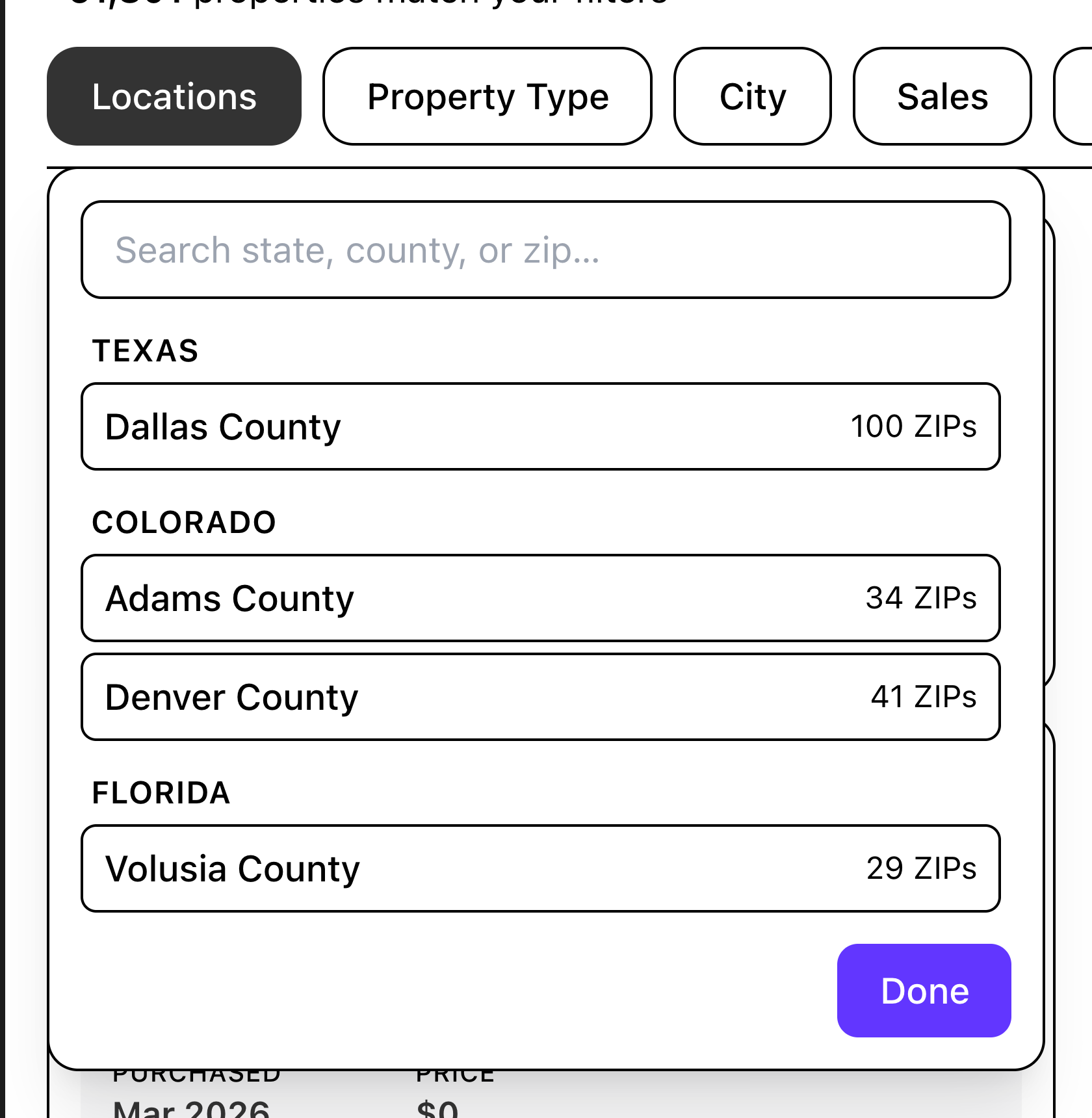 A state, county and ZIP tree under one search box.
Crowding is not the same as market size
The instinct is to equate a big market with a busy one and a busy one with a competitive one. The data unpicks that.
Dallas holds about 13,038 investor-owned properties with 2,117 active investors — roughly six properties per investor, the most crowded city in our DFW coverage. Garland is also about six. Plano, Allen, Frisco and Melissa all sit near eight.
Meanwhile Celina sits near 20, Denton near 25, and Little Elm near 18.
So the established urban cores are where buyers are most densely packed, and the fast-growing exurbs are where each individual buyer is largest. That is the reverse of how the boom towns feel from outside, where it looks like everyone is piling in.
What a crowded market demands
In Dallas or Garland, you are one voice among many chasing the same older houses.
Speed is the advantage. Several buyers will see the same opportunity. Getting there first with clean numbers matters more than a polished relationship.
Breadth beats depth. No single buyer is a meaningful share of demand, so a wide list is a real asset. Losing one contact costs little.
Qualification is the bottleneck. With 2,117 active investors in Dallas, finding buyers is trivial. Working out which of them wants your specific property is where the week goes.
What a thin market demands
In Celina or Denton, the shape inverts.
Each relationship carries weight. A buyer holding twenty-plus properties and still acquiring is a repeat outlet, not a transaction. The list is short enough to know properly.
A bad fit is expensive. When a few dozen entities represent most of the demand, burning one on a property that was never going to suit them is a real loss.
Research pays off. With 567 active investors rather than 2,117, it is actually feasible to learn the serious ones — what they buy, what they refuse, who answers.
Neither market is easier. They reward opposite habits, and importing one city's habits into the other is how people conclude that a market is "dead" when it simply required a different approach.
The ratio moves with the stage of growth
There is a pattern worth noticing across DFW.
The towns being built right now — Celina at 20 properties per investor, Lavon at 15, Anna at 14 — have fewer, larger buyers. These are builders and land investors operating at scale, and there are not many of them relative to the property.
The mature suburbs — Plano at 8, Allen at 8, Frisco at 8 — have more, smaller buyers. The construction phase is over, the housing is in individual hands, and the investor market is made of people with a handful of properties each.
The urban cores — Dallas at 6, Garland at 6 — are the most fragmented of all.
That is not a rule you should lean on hard, but it is a useful prior: the earlier a market is in its build-out, the more concentrated its investor base tends to be.
Outside DFW the range is wider still
Step out of one metro and the spread gets dramatic.
Columbus, Ohio runs about 73 properties per active investor — by far the most concentrated city in our coverage. Charlotte, North Carolina about 27. Aurora, Colorado about 22. Durham, North Carolina about 21. Greensboro, North Carolina about 16.
At the other end, Denver, Colorado sits near 9, close to the Dallas and Garland figures.
Columbus is worth dwelling on. About 43,217 investor-owned properties held by roughly 595 active investors, with condominium units as the most common type at about 993 square feet. That is a small number of entities assembling large numbers of small rental units — an institutional shape, and one where a buyer list of forty names could plausibly cover most of the real demand in a city of that size.
Compare that to Dallas, where 2,117 investors hold about 13,038 properties. A forty-name list in Dallas covers almost nothing.
Same country, same product category, two completely different jobs.
What the number will not tell you
It is an average, so it hides the distribution. Celina at 20 could be a handful of large builders plus many small holders. The average describes the middle of a range, not a typical buyer.
It says nothing about appetite. Little Elm sits near 18 properties per investor, but its turnover is about 18% and its purchase pace fell to roughly 0.64 of the prior year. Concentrated and slowing at once. Crowding and activity are separate questions.
It is not a difficulty score. A crowded market has more competitors but also more transactions. A thin one has fewer competitors but fewer chances. Neither is objectively harder.
The check
One division, three readings:
Under about 10 — crowded. Build wide, move fast, accept that most buyers will pass.
Around 10 to 25 — mixed. Know the core by name, keep a tail behind them.
Over about 25 — thin. Short, deep list. Learn the major holders properly.
Then check turnover and pace separately, because the question "how many buyers am I competing with" and the question "are those buyers actually purchasing" have different answers in the same city.
Write the answer down for every city you work. The shapes change slowly, so this is a once-a-quarter exercise at most, and having the numbers side by side keeps you from quietly applying one city's playbook in another.
The failure this prevents is small but common: choosing a market because it looked busy, building a list the way you always build one, and never understanding why the same approach that worked twenty miles away produced nothing here.