
The Problem With a Raw Buyer List
You have a contract. You need an end buyer. So you pull a list of cash investors in the county—maybe it's a hundred names, maybe it's three hundred—and start calling.
By call twenty you notice something: half the numbers are dead. A third of the people who pick up haven't bought anything in years. One investor listens politely and says they only buy in a different state now. Another says their partner handles deals and you need to track him down. You burn through your dials and your callback rate stays flat.
That's not a buyer list. That's a name dump. A real buyer list tells you three things before you dial: Is this investor actually buying right now? Do I have a working number for them? And does my deal match what they actually buy? Without those three filters, you're not prospecting—you're cold-calling.
Why the Usual Approach Wastes Your Time
Most wholesalers build a buyer list the slow way: they collect names over time, add them to a spreadsheet, and call whoever they remember. The list gets stale fast. An investor who bought five deals last year might have moved to another state or switched strategies. A number that worked three months ago is disconnected. You have no way to know which names are still active and which are dead weight.
Other wholesalers buy a lead list from a vendor and assume every name on it is a working buyer. They're not. A name on a list might be an active investor in one county and dormant in another. A phone number scraped from a website might be an old office line. You have no signal for who is actually buying, and no way to verify contact details before you waste a call.
The result is the same: you call a lot of people who are not in the market, or not in your market, or not reachable. Your callback rate stays low. You spend more time chasing dead leads than closing assignments.
What Actually Predicts a Callback
An investor who will take your call has two things in common: they have bought recently, and you have a way to reach them. That's the signal. Tenure doesn't matter—a buyer active for three months will call you back faster than one inactive for five years. Lifetime deal count doesn't matter. What matters is what they bought last quarter and whether you have a working phone number.
Recent activity tells you the investor is still in the market and actively deploying capital. It tells you they close deals. It tells you they have a team in place and a system that works. You're not calling to convince someone to start investing—you're calling to offer them a deal that fits what they are already doing.
A reachable contact detail—a phone number, an email, a social profile—is the gate. If you don't have it, the deal doesn't matter. If you do, you have a shot. Everything else is noise.
How to Read a Market for Workable Buyers
Start by scoping to the exact geography you're working. A buyer active in your county might not be in an adjacent one. A ZIP filter is sharper than a county filter, but county is the minimum. You're building a list for a specific deal or a specific territory, not a whole state.
Next, filter to investors with recent activity. This is the biggest lever. "Active" means they have bought within a timeframe that suggests they're still transacting—recent enough that capital is moving, old enough that you're not calling a deal in flight. Different investors operate at different speeds, but the signal is clear: if you see recent buys, someone is home.
Then filter to investors with reachable data. This means a phone number, or an email, or a social profile where you can message them. A name alone is not a lead. A name with a disconnected number is worse than no name. You want investors where contact information exists on file.
Once you have those three filters set—location, recent activity, reachable contact—you have a list worth calling. Everything else is preparation for the conversation.
How to Build the List in Agreedment
The fastest way to move from a whole market to a callable list is to filter in layers. Start broad, then narrow.
- Click the Locations pill in the filter bar.
- Search for your county or ZIP and select it from the dropdown. The count under the dashboard title updates to show how many properties are in that geography.
- Click the Investor pill to filter by owner, not property.
- Under Activity Status, select Active. This shows investors who have bought recently and are still transacting.
- Scroll down to Data Available and toggle Has Phone. This removes investors with no reachable number.
- Click Apply. Your filters appear as removable chips under the toolbar.
 The whole flow: Investor, Activity Status, Has Phone, Apply.
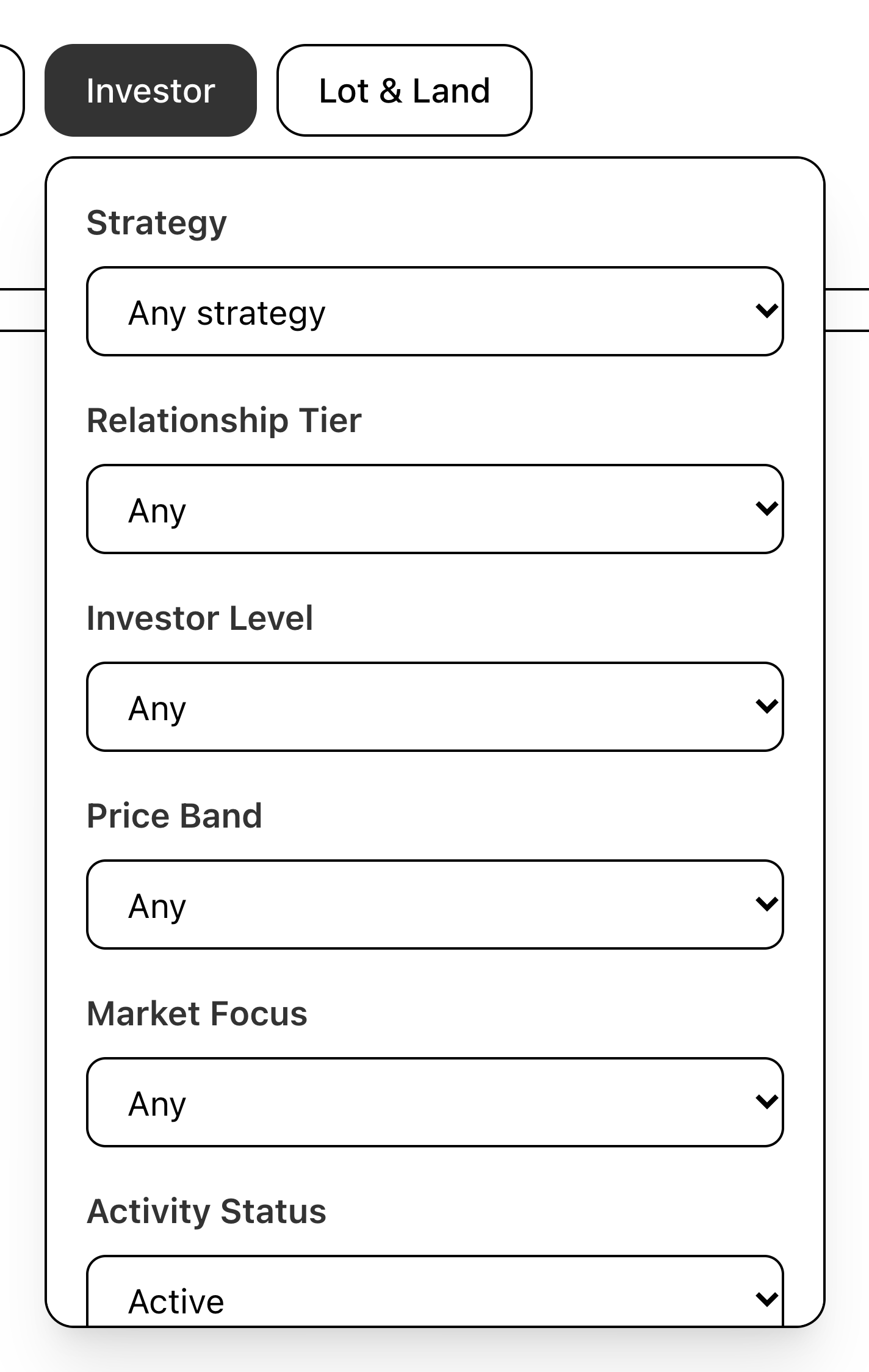 Activity Status separates investors still buying from those who have gone quiet.
That's your list. What you see now are investors in your geography who are buying now and have a working phone number. The count has dropped—maybe by half, maybe more—but what remains is callable.
Narrowing Further: Match the Deal to the Buy Box
Now you have a list of active, reachable investors. But not every one of them will buy your deal. Some buy only multifamily. Some focus on rental properties and hold them. Some have a minimum purchase price that's way above your contract. You can narrow further by opening a buyer's profile and reading their buy box—the price range, property types, and deal strategies they actually pursue.
Open any investor from your filtered list. Their Buy Box section shows their typical purchase price, the property types they target, and their preferred strategy. This is built from what they have actually bought, not what they claim to buy. An investor who says they buy anywhere will show a tight buy box in their data: the truth always emerges from the deals.
Match your contract to that box before you call. If your deal is a single-family rental in the forty-to-sixty range and their box is flips in the one-hundred-to-one-fifty range, you can skip that call. If your deal matches, you have a reason to call beyond just having their number. You can open with: "I have a property in your area that fits your price range and strategy," and mean it.
This step cuts your call list even tighter. But the calls you do make connect. You're not interrupting—you're offering.
Add One More Layer: Cash Purchases
On the Regional plan and above, you can filter further to investors who have bought with cash. Toggle Cash Purchase in the Data Available section before you apply. This removes buyers who typically finance, and surfaces the ones who have the capital to close on your assignment without contingencies.
You can also toggle Has Email or Has Social if you want to add those contact methods to your list. A wholesaler with multiple contact paths can reach an investor more ways.
 Entity Search: press Enter or Apply to search by owner name.
Five availability chips, plus Entity Search for finding one owner by name.
Each filter you apply makes the list smaller and the callbacks bigger. The goal is not to call everyone—it's to call the right people.
What to Do With Your List on the Next Call
You have a list of active investors with working numbers whose buy boxes match your deal. Now the list becomes a script. When you call, you lead with specificity, not hope.
"Hi [Investor], I have a property in [Location] that matches what I've seen you buying. Single-family, mid-[Price Range], needs some work, and the numbers work for an assignment." You're not asking if they buy—you're saying you have something that fits what they actually buy. You're not hoping they'll call back—you're giving them a reason to take the call.
If they ask your price, you have their purchase history to reference. "Last year I saw you close three similar deals in the forty-to-sixty range. This one is at forty-five." You're not guessing at their appetite—you're talking about the deals they've already done.
If they say "that's too high," you can say "I saw you close one in this ZIP for sixty-two, two years ago. The market's moved," and keep the conversation grounded in data instead of opinion. (For a deeper dive on that conversation, see "Answering 'That's Too High' With the Buyer's Purchase Record.")
If they're not the right fit, you remove them from your list and move to the next. You have no time to convince someone to buy outside their box. But because your list is filtered to active, reachable investors with matching buy boxes, your next call is warmer than the last.
Building the Habit
A buyer list is not a one-time project. Markets move. Investors come and go. New capital enters. Money gets tied up. An investor who was active last quarter might be cooling off this one. Someone who was dormant might be re-entering.
Every time you're ready to work a new deal or enter a new market, filter fresh. It takes two minutes. A cached list from three months ago will waste your time. A fresh filter—location, active investors, reachable contact, matching buy box—will save it.
The difference between a raw list and a workable list is just asking the right questions before you dial. Is this person buying now? Can I reach them? Do they want what I have? Filter for the answers and your callback rate will show it.


