
The Land Problem: It's Not Residential
Land deals move differently than single-family houses. A cash buyer who closes three flips a year and has a tight buy box for rehabs is not going to close your vacant lot. The investors who buy land have different capital structures, different hold horizons, and different acquisition patterns. Call the wrong buyer about raw acreage, and you burn a call without learning a thing about whether your deal even has a shot.
The trap most wholesalers fall into is treating land the same way they treat residential. You pull a list of "cash buyers" in your market, start dialing, and discover halfway through that half of them don't touch land at all. The other half buy land, but only 5-acre parcels, and your deal is a 0.5-acre corner lot. You spent the morning on the phone and learned nothing except what doesn't work.
Why Your Residential Buyer List Doesn't Work for Land
A buyer's lifetime deal count tells you nothing about whether they buy land. Neither does their recent activity in single-family. The data that matters is what they actually acquired in the past year—and whether any of it was raw ground.
When you look at a buyer's portfolio, you can see property type. Single-family, multi-family, commercial, industrial, land. A buyer might have closed fifteen deals and zero of them were land. Or they might have bought land, but only in a specific county, or only in a specific size range. A deal in the wrong size or the wrong part of the market gets rejected on the phone before you finish the pitch.
The second problem is lot size. Land buyers are extremely selective about acreage. A developer buying for subdivision has a minimum lot size. A builder stacking townhomes has a different minimum than a single-family developer. An investor buying for land banking has another threshold entirely. You cannot know if your lot fits without knowing what that buyer has actually purchased.
The third is strategy. A land buyer might be a developer, a wholesaler working land themselves, a speculator, or a builder lining up inventory. Each one makes different decisions about price and location. A speculator can pay differently than a developer because they hold it differently. Knowing the strategy from their own record means knowing whether your assignment fee lives in that deal.
What to Filter On: Property Type and Lot Size
Instead of starting with a name and a number, start with the deal. You have a land contract. That land has acreage. It has a location. A buyer who makes sense for it is a buyer who has recently acquired similar land in similar sizes in similar locations.
Filter your market to investors whose recent purchases are actually land. Then filter those to investors whose lot sizes match yours. That is the short list worth calling—and it is vastly shorter than your full cash-buyer database, which is exactly why it works. You are not eliminating buyers; you are eliminating wasted calls.
The deal frequency matters too. An investor who bought one parcel three years ago is not an active land buyer now. An investor who has acquired land in three of the past four quarters is. Active means recent and repeated. A dormant buyer, no matter how much land they have bought historically, is not your best call.
Finding Land Buyers in Your Market
Locate your market and filter to recent acquisitions by property type. On the Regional plan and above, you can filter investor portfolios to show only land deals and see the lot sizes those investors have acquired.
- Click the Locations pill and search for your county or ZIP.
- Click the Property Type dropdown and select Land.
- In the filters, select Recent Activity to show only investors who have purchased land in the past year or quarter.
- Sort by Average Lot Size to see the range of acreage each investor tends to buy.
 Search, then click the county to scope everything to it.
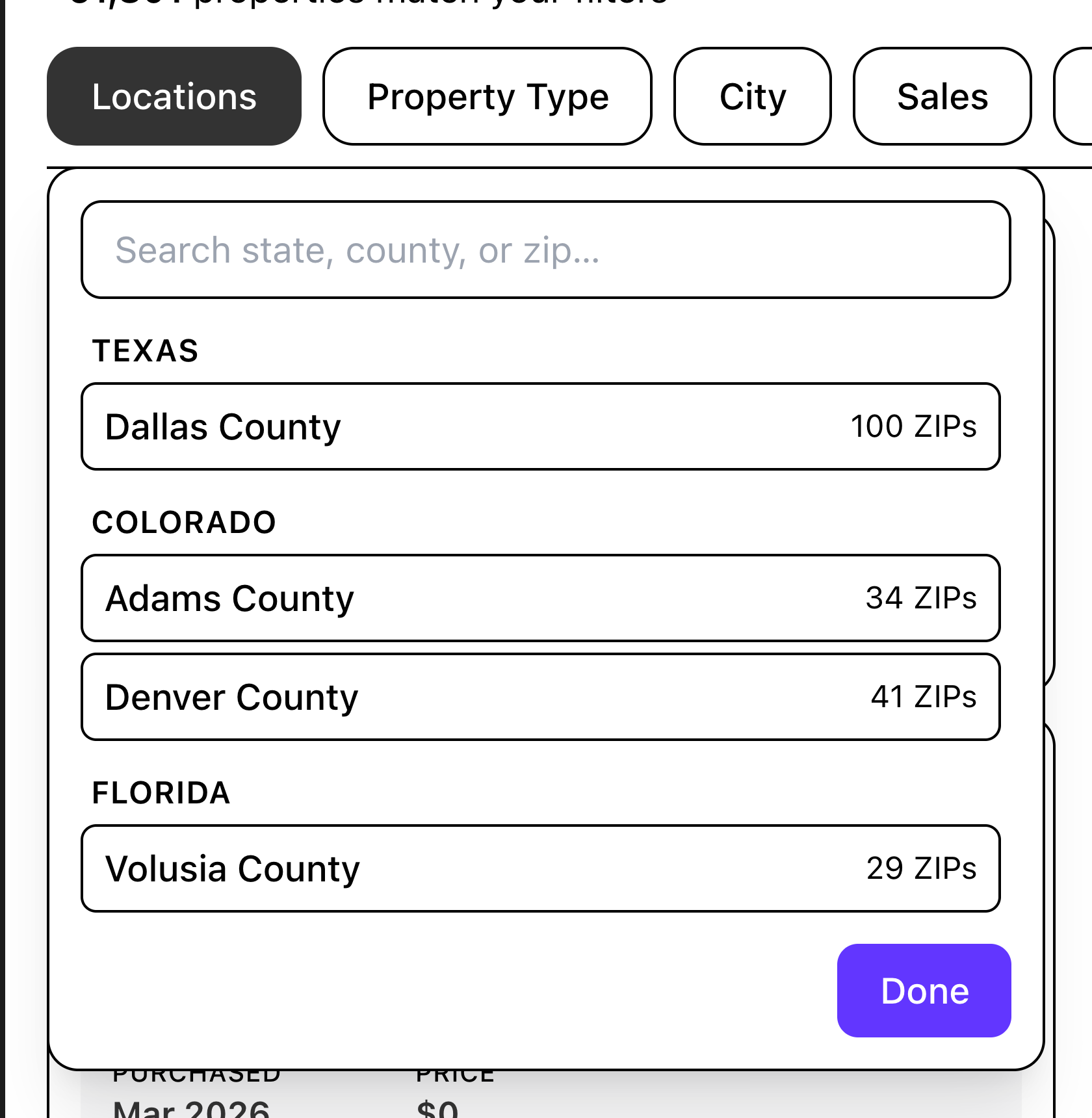 A state, county and ZIP tree under one search box.
What you are looking at now is a list of investors who have demonstrated that they buy land, how much acreage they tend to acquire, and how often they have acquired it. This is not a guess about their business model. This is their actual record.
The Buy Box for Land
When you open an investor's profile, the buy box for land reveals the same things it reveals for residential: what they have actually purchased, the price range, the property types. For land, the lot-size range is the essential read. An investor who has acquired lots between 0.75 and 2 acres is not going to close a 0.25-acre infill parcel, no matter how good the location or the price.
The portfolio on file shows not just the lot size but the location pattern. Is this buyer concentrating in one ZIP or one county, or are they spread across the region? Are they buying at highway frontage or interior residential? Are they buying spec land or land banking?
The deal frequency and timeline matter just as much. If the most recent acquisition was six months ago and the one before that was a year prior, you know this is an active buyer. If the most recent deal was two years ago, do not waste the call expecting an immediate close.
What to Say on the Call
You now have a buyer whose recent record shows they acquire land at your deal's lot size, in your deal's market, within the past quarter. That is a better starting point than a generic list.
On the call, lead with specificity. "I saw you acquired a 1-acre parcel at [location] last quarter. I have a 0.9-acre lot available in [your neighborhood] at [price]. Does that fit your criteria?" You have already qualified the buyer—they have proven they buy this size in this market. The conversation is now about the specific deal, not whether they buy land at all.
If they say "That's too high," you can reference their actual acquisitions. "I saw you closed on similar acreage in this ZIP at [price point] in the past year. Help me understand what has changed." Their own record becomes the baseline, not a comp site or an appraisal.
If they say "Not our market," you can drill in. "You acquired land in [nearby ZIP] three months ago. Is the issue price, or are you not active in this ZIP specifically?" You know what they have bought; now you know why they might pass.
Wholesaling Land Without Confusion
The wholesaler's job is the same whether the deal is a house or a lot: find a property at a price that works, contract it, match it to a buyer. The efficiency gain on land is that the buyer profile is more distinctive. A residential cash buyer is a category. A land buyer is almost a niche within a niche—by lot size, by strategy, by market.
Once you filter to investors who have actually bought land your size in your market, the call is shorter, the callback rate is higher, and you spend less time on distractions. You are calling investors whose buy box matches your contract, which is the point of every assignment call. Land just makes the match more visible on the screen before you pick up the phone.
If you are new to land wholesaling or moving into a new market, start here: find one investor who has recently bought land at your deal's lot size in your deal's location. Call that one investor first, before you build a whole list. Their feedback will tell you if the deal is priced right, if the location is hot, and if the size is marketable at all. Build outward from that one real anchor, not from a generic database.


