
The Land Buyer Problem
Land is a different game from single-family houses. The buyers who close on your residential flips may not touch raw land at all. Institutional investors hunt single-family portfolios; fix-and-flip crews want a structure to renovate. But land attracts a narrower set: developers, builders, hold-and-hold investors waiting for zoning to shift, and owner-operators who are hunting for their next build site.
If you are sourcing land deals and calling the same buyer list that works for residential, you will spend calls on people who do not buy land. That is wasted motion. The answer is not to call more buyers; it is to call the right ones.
Why Residential Buyer Lists Miss Land Deals
A cash buyer who has closed twenty house flips is not automatically a land buyer. Their portfolio will tell you: if the last fifty acquisitions are single-family homes with structures, they are optimized for renovation, not raw land. Calling them about an empty lot is a mismatch, regardless of price.
The second miss is lot size. Land buyers often have a specific requirement—a 2-acre minimum for a subdivision build, or exactly 10,000 square feet for a tight infill. A residential buyer who works 0.25-acre lots may reject a 5-acre parcel not because of price, but because it does not fit their playbook. Calling without knowing that threshold wastes both of you.
Third, land strategy is visible in the data before you pick up the phone. Some land buyers hold; some flip quickly; some are assemble-and-develop crews. A wholesaler who does not know which type they are calling will get rejected on strategy alone.
What to Look For in a Land Buyer
The buyer's purchase history answers the question for you. If they have closed raw land deals in the timeframe you care about—the last year or two—they buy land. If their lot sizes cluster around your inventory, they are the right size buyer. If they are recent and active, they are still in the market.
Three data points matter:
Purchase type. The buyer's recent acquisitions should include vacant land, not just improved lots. This is the first filter. If their portfolio is all single-family or multi-family structures, keep digging or move on.
Lot size and acreage. Land buyers often have a working range. A builder may focus on half-acre to two-acre sites for townhome projects; a developer may need ten acres minimum. Reading the size profile of their recent purchases tells you whether your lot is even in scope.
Activity and frequency. A buyer who closed one land deal three years ago is not a land buyer; they are a residential buyer who tried land once. Activity means recent, repeated acquisitions. A buyer with three or four land closings in the last twelve months is in the market now.
How to Filter to Land Buyers in Agreedment
On the Multi-Regional plan, land is a filterable property type, and lot size is available as a search dimension. You can build a list scoped to your actual market opportunity in a few minutes.
Start by narrowing your geography to the specific county or ZIP where you are sourcing land.
- Click the Locations pill.
- Type a state, county or ZIP into Search state, county, or zip....
- Drill down state, then county, then ZIP. Click 100 ZIPs to expand a county and Hide to collapse it.
- Clicking a county filters to it straight away -- no Apply needed.
 Search, then click the county to scope everything to it.
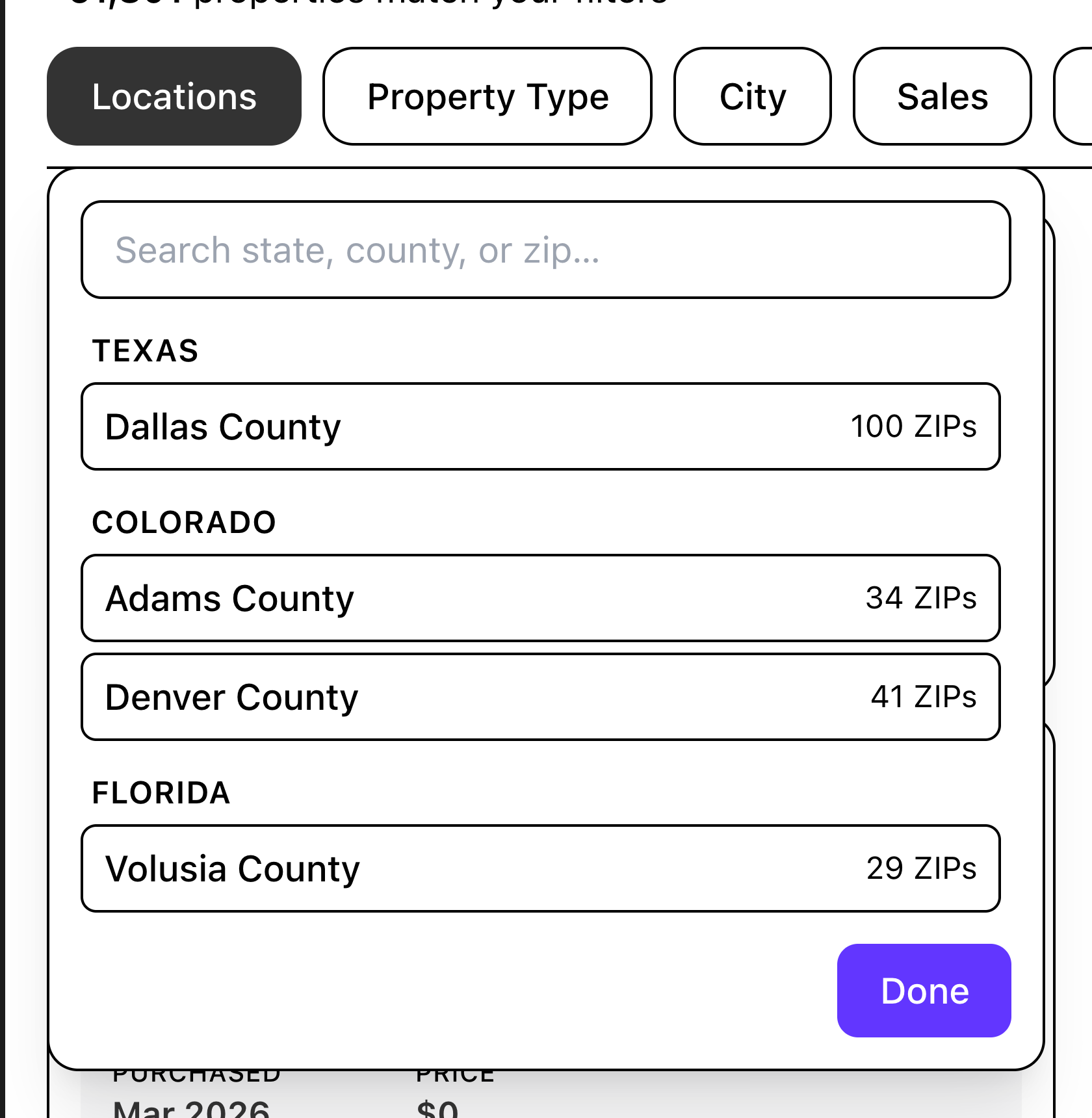 A state, county and ZIP tree under one search box.
Next, filter to properties that are actually land, not improved lots.
- Click the Lot & Land pill.
- Set a Year Built minimum and maximum. For vacant land, set the maximum to an early year—this filters to properties with no structure or very old ones.
- Lot size is filterable in SqFt, Acres, Depth and Frontage. Set the range that matches the land you are sourcing. Return values to Select to clear.
 Year Built plus four ways to size a lot.
 The Lot & Land panel.
Now filter to the buyers who have actually purchased land in this geography at this size.
- Open the Dashboard. The count under the title is how many properties match your filters; this is your pool of land deals.
- Click the Investor pill in the filter bar. This panel describes the owner, not the building.
- Under Activity Status, choose Active -- investors who have bought recently and are still transacting.
- Scroll to Data Available and click Has Phone.
- Click Apply. Your filters appear as removable chips under the toolbar and the count updates.
You now have a list of active land buyers in your county, sized to your lot specifications, with phone numbers. These are the people to call.
How Land Buyers Decide
Land buyers move faster than residential buyers in one respect and slower in another. The speed comes from lack of due diligence—no inspection, no rehab timeline, no appraisal risk. The slowness comes from strategy and entitlement. A land buyer will ask about zoning, utilities, and access before they ask about price. They are not buying to flip in 120 days; they are buying to build, develop, or hold.
When you call, you should have three things ready: the exact lot size and shape, the current zoning and any entitlements, and your assignment fee. Lead with lot size and zoning. If those do not fit, the price does not matter. If they do fit, the buyer will ask about access, neighboring properties, and whether the land is assemblable with adjacent parcels. That is how you know they are serious.
Land buyers also care about speed to close. Raw land financing is simpler than residential—many close cash without appraisal—but the process is different from house deals. If your buyer is an experienced land operator, closing goes faster. If this is their first land deal, they may take longer. The filters above help you find the experienced ones.
How to Use the Data on Your Next Call
When you call a land buyer from your filtered list, you are calling someone whose recent purchases prove they buy land, whose portfolio shows they like your lot size, and whose activity level proves they are still buying now. That is three rejections you have already ruled out before you dial.
On the call, open their recent purchases and their portfolio. Ask what they are actively buying right now—their answer will tell you whether your deal fits. Ask whether they have done land in your neighborhood or county before. If they have, they know the zoning and the market. If they have not, they will need more education, and that takes time.
If they say yes to your deal, move fast. Land deals close when the buyer has certainty on entitlements and title. Get a proof of funds immediately—a land buyer who hesitates on proof of funds is a tire-kicker. Double-close if needed; most land buyers understand double-closing on land assignments because title insurance and closing mechanics are different.
If they pass, ask why. If it is size or zoning, note that for future calls to similar buyers. If it is price, ask what they would pay and keep that number for your next sourced deal in that area. Land buyers have consistent decision frameworks, and each no teaches you something for the next call.


