Venus, FL Investor Market Snapshot
What cash buyers have been doing here in the last 12 months.
Data last updated
In Venus, investors own about 25 tracked properties across 5 active buyers, with a median investor purchase price near $50,000. 1 were acquired in the last 12 months.
Acquisition Activity
Property Characteristics
Investment Strategy Mix
Hottest ZIP codes for investors
What the Venus numbers mean
The Venus market at a glance
Acquisition pace is cooling: 1 properties bought in the last 12 months against roughly 12 the year before, down about 92%. Fewer buyers are competing per deal, which usually means more room to negotiate but a longer search for the right one.
4.0% of the investor-owned stock in Venus was bought within the last 12 months. That is slow turnover — long holds, few sellers, and a premium on finding the owner who is finally ready.
Across Venus, 5 active buyers account for approximately 25 investor-held properties. Averaging below 0.2 purchases per buyer last year, this is a wide, shallow pool — a numbers game where reach beats depth.
The median investor purchase lands near $50,000. The gap between that median and the $304,000 average is the story here — a few outsized trades, with the real volume well underneath them.
Housing stock and strategy
Residential Vacant Land is the property type investors buy most in Venus.
The dominant play is buy & hold, at 100.0% of tracked activity. Because these buyers underwrite to cash flow, a credible rent figure moves a deal further than a renovation estimate.
The rest of the mix is new construction (0.0%) and value-add / rehab (0.0%). Those secondary buyers are worth a line on your list — they tend to see less competition for the same contract.
Venus versus its Highlands County neighbors
Set against the other communities in Highlands County, Venus comes in 5th out of 5 for investor buying (1 purchases in 12 months). A typical community in the county logs 280, so this is one of the quieter corners — less competition, smaller buyer pool. Put another way, under 1% of the county's investor deals in the last year happened here.
Momentum runs against Venus: purchases are down 92% year over year, 198 points behind the county (up 106%).
Lorida behaves most like Venus on volume and price (12 purchases, $23,000 median), which makes it the natural second market to work. For scale, the county's busiest community is Sebring, at 2,266 investor purchases.
Venus is one of the pricier stops in the county, with a median purchase of $50,000 against $34,000 for its typical neighbor — 47% higher. On price it sits between Avon Park ($45,000) and Sebring ($407,000).
| Community | Active buyers | Purchases (12 mo) | Year over year | Median price |
|---|---|---|---|---|
| Sebring | 216 | 2,266 | +166% | $407,000 |
| Lake Placid | 143 | 423 | +13% | $11,000 |
| Avon Park | 78 | 136 | +24% | $45,000 |
| Lorida | 10 | 12 | +200% | $23,000 |
| Venus(this page) | 5 | 1 | -92% | $50,000 |
Reading Venus from every seat in the deal
From the owner's side, Venus is quiet. Many owners here have not been approached recently and have no current sense of what their property would fetch, which cuts both ways: less fatigue to overcome, and a price expectation anchored to whatever they last heard, possibly years ago.
At $50,000, financing is often beside the point — the buyer simply writes the check. The practical consequence is speed, and a competitive field where availability matters more than terms. Low turnover suggests longer holds, whether by intent or because exits are slow here. Either way the buyer is accepting carry, and a property that generates income during the hold is worth materially more to them than one that sits empty.
The typical Venus buyer is holding ground, not operating a property, so speed matters less here than basis. At $50,000, buyer intent matters more than price. The number alone does not tell you whether you are talking to renovation money or hold money, and those two want opposite things.
A wholesaler should go into Venus with clear eyes: only about 4% of investor-held property traded in the last year, which is bottom-quartile turnover. There is investor money here, but it is sitting rather than cycling. With only 5 active buyers, relationship risk is real: lose one and you have lost a meaningful share of your exit options. Markets this thin reward depth over volume, and reward having a second area in rotation.
There is a crowding problem worth naming: 5 active buyers against 1 purchases over twelve months means fewer than one completed deal per buyer per year. Most of these buyers did not transact recently, so a contract here meets competition on the buy side — and an assignment fee priced as though buyers are desperate will not survive contact. Land-heavy markets see less wholesaler competition, because land requires a different conversation. That is a moat for anyone willing to learn the entitlement side.
Putting the Venus numbers to use
A pool of 5 is thin, and thin pools fail suddenly rather than gradually. Treat Venus as one market in a set, not as a pipeline on its own. There is also a valuation trap. The average purchase runs well above the median here, which means a handful of outsized deals are inflating the mean — and anyone pricing a contract off the average will set a number no typical buyer in Venus will meet. The median is the honest anchor; the average describes transactions you are probably not part of. One structural caveat applies to all of it: these figures come from recorded transactions, which lag the market by weeks to months depending on how quickly the county records. A market that turned last month looks unchanged here, so treat the numbers as a reliable description of the recent past rather than a live feed.
Deals that land near $50,000 — call it $43,000 to $57,000 — are the easiest to place here. With buying this spread out, plan to put a deal in front of dozens of the 5 buyers rather than a handful. In a cooling market, price the assignment conservatively — buyers have options and they know it.
Activity is not spread evenly. ZIP 33960 absorbs the most investor purchases in Venus, and it is the fastest place to start a buyer list.
For outreach, there are 9 contact records tied to buyers in Venus inside the platform — more than one per active buyer.
If Venus is new to you, the first move is narrowing rather than broadening: build a shortlist of roughly 3 buyers whose recorded purchases match the kind of property you can actually source, and learn those names properly before widening. A small list worked well outperforms a long one worked thinly, and the data to build it already exists in the purchase record. Third, plan for a longer cycle. With stock moving slowly, expect weeks rather than days between a contract and a committed buyer, and price the assignment so that patience is affordable. A fee that only works on a fast close will not survive this market.
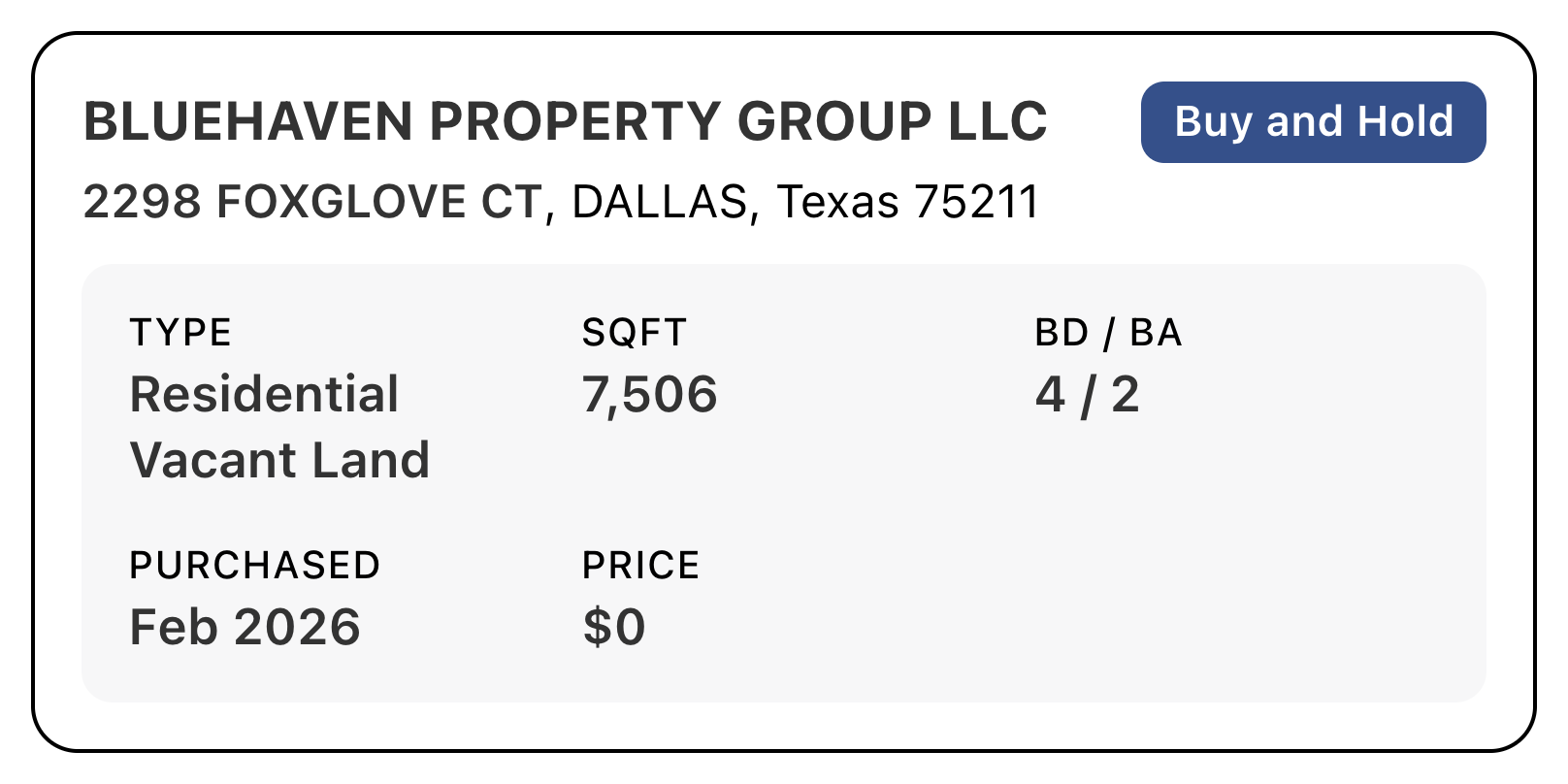
Counts and prices here are drawn from recorded investor purchases in this city and refresh with new records. They are a record of past activity, not a forecast or investment advice.
Cash buyers by ZIP in Venus
Popular searches around Venus
Questions buyers ask
- How many investors are active in Venus?
- There are 5 active investors owning 25 tracked properties in Venus.
- What is the median investor purchase price in Venus?
- The median investor purchase price is about $50,000 in Venus.
- How active is the Venus investor market recently?
- 1 properties were acquired by investors in the last 12 months in Venus.
- Is there recent new-construction investor activity in Venus?
- 0 new-construction homes were acquired by investors in Venus in the last 90 days.