
In Celina, about 91% of investor activity is new construction. Twenty-five minutes south in Garland, it is 1%.
That is the same metro, and it is the reason advice about Dallas-Fort Worth buyers travels so badly. What people tell you about Plano has almost nothing to do with what happens in Grand Prairie. It is not inconsistency — there are two different investor markets stacked on top of each other in DFW, and the line between them runs roughly along the northern edge of Dallas County.
Knowing which side you are on is the most useful thing you can establish before you start calling.
North of the line, investors are building
Go up into Collin and Denton counties and the numbers look strange if you are expecting flips.
Lavon runs about 96% new construction. Princeton is near 88%, Celina 91%, and the Denton County portion of Fort Worth about 84%. The median investor-owned property in these towns was built in 2025 — not renovated in 2025, built. In several of them the most common investor-owned property type is not a house at all. It is vacant residential land.
So the buyers up there are builders and land buyers. They are not shopping for a bad roof and good bones. They are buying lots, putting houses on them, and the pace is real: Celina alone shows roughly 4,495 purchases in the last twelve months against 11,243 investor-held properties, meaning about 40% of the book turned over inside a year.
Bring a 1970s fixer to a Celina buyer list and you will get polite silence. It will not be because the market is slow.
Inside Dallas County, investors are rehabbing
Now the other half. Grand Prairie: 60% value-add, 4% new construction, median year built 1972. Garland: 58% value-add, 1% new construction, median 1976. Dallas proper: 37% value-add across 13,038 investor-held properties, median 1984.
That is the market most wholesalers picture when they say "cash buyer." Older housing, buyers who want condition problems because the problems are the margin, exit by resale.
Same metro, opposite thesis. A buyer in Garland and a buyer in Celina are both accurately described as Dallas-Fort Worth cash buyers, and you would show them completely different properties.
The middle band is genuinely mixed, and that is where guessing hurts
Between the two extremes a group of suburbs does both, and these are the ones worth checking individually rather than assuming.
Frisco runs about 52% new construction with 453 active investors. Prosper is 63%. Melissa and McKinney are both near 69%. Wylie drops to 36%. Allen comes in at just 20% despite sitting in Collin County surrounded by towns that are mostly new builds.
Allen is the instructive one. If you assumed Collin County meant new construction, you would have the strategy backwards in a city with 370 active investors. It sits in the north but behaves like an established market, because it largely finished developing before its neighbors did.
The lesson is not that Allen is unusual. It is that county-level assumptions break at the city line, which means the city is the level worth scoping to.
Scope to the city, not the metro
This is where working from a metro-wide list goes wrong. "DFW cash buyers" blends a land buyer in Lavon with a rehabber in Garland, and the blend describes neither.
Scoping down is two panels. Click the Locations pill, type a state, county or ZIP into Search state, county, or zip..., and drill down state, then county, then ZIP. Clicking a county filters to it immediately, with no Apply needed. 100 ZIPs expands a county's ZIP list and Hide collapses it again.

Search, then click the county to scope everything to it.
Once a county is scoped, the City control becomes available — until then it reads "Select a county first." Pick the city and you are looking at Allen rather than at all of Collin County, which given the 20% versus 69% gap is a materially different set of buyers.
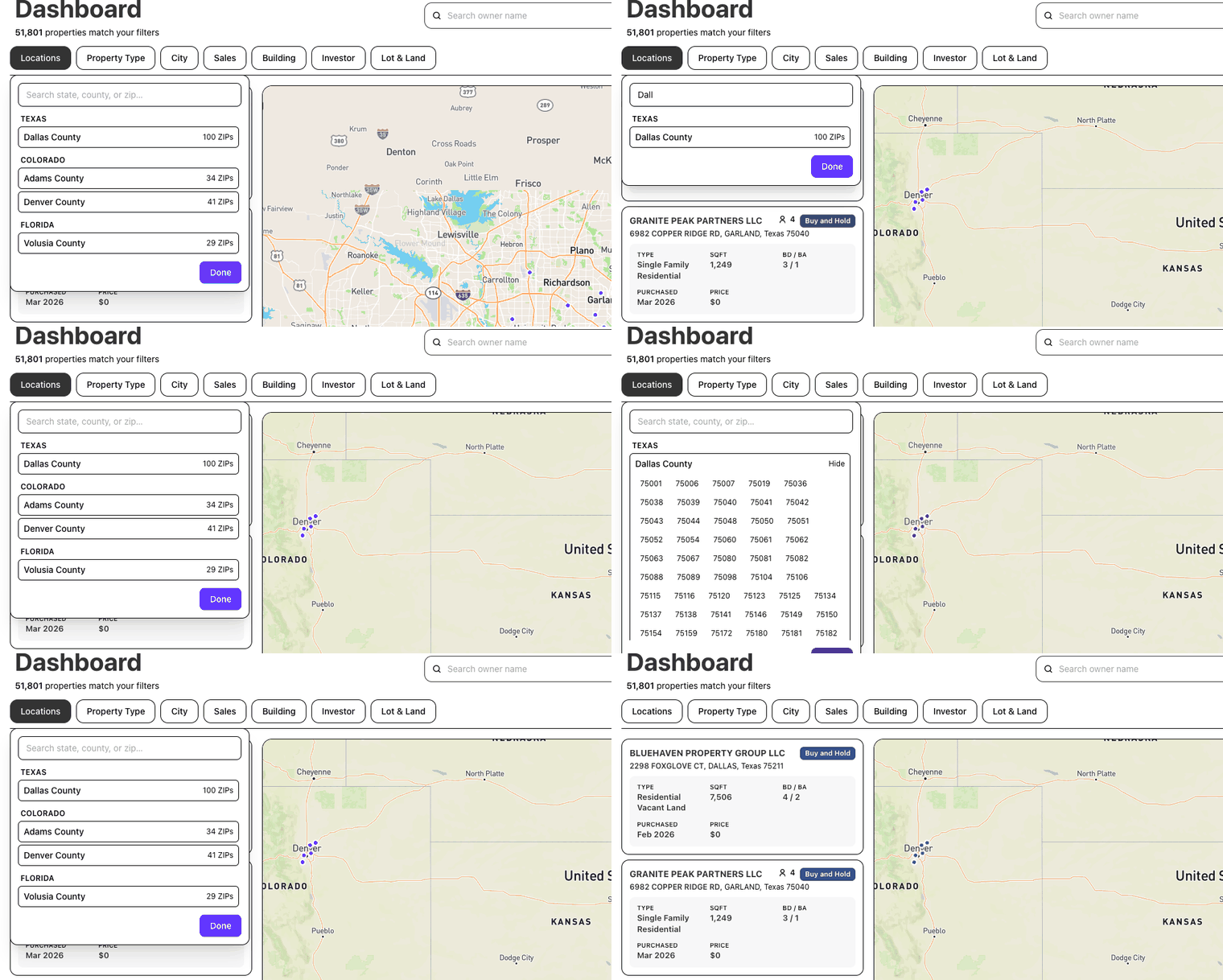
Expanding ZIPs only looks; it does not filter.
Worth knowing: expanding the ZIP list is a view, not a filter. It shows you what is in the county without narrowing anything.
Filter for the buyer type the half you are in actually produces
Scoping the geography is half the job. The other half is matching the buyer to the market's thesis, and north DFW makes this unusually concrete.
In the Investor panel, scroll to Data Available and you get five chips: Has Phone, Has Email, Has Social, New Construction and Cash Purchase. A chip fills purple when it is on, and the chips only take effect when you click Apply.

Five availability chips, plus Entity Search for finding one owner by name.
Working Celina or Princeton, New Construction is the chip that matches what those markets are. Working Garland or Grand Prairie, it is the wrong filter entirely and the Strategy dropdown's Fix & Flip is closer to the point. Pair either with Has Phone and you have a list you can work this afternoon rather than a market summary.
Nothing changes until you hit Apply, so exploring the panel costs nothing.
Buyer count and buyer reach are different problems
One more pattern, because it is counterintuitive.
Dallas has 2,117 active investors, far more than anywhere else in the metro. McKinney has 1,144, Plano 471. Little Elm has 105, Pilot Point 77, and the Fort Worth slice of Denton County just 45.
Raw count is not the whole picture though. Plano shows roughly five reachable contacts per active investor and Allen about six, while Little Elm and Pilot Point run closer to two. Denser contact coverage means that when you find the right buyer profile you can usually reach a person, rather than stalling at an entity name.
Practically: a market with fewer buyers but better reach can be easier to assign into than a larger one where nobody picks up.
What to check before you call
Three things, in order.
Which half is the property in? North-of-Dallas-County towns skew heavily to builders and land; Dallas County skews to rehabbers. That determines whether your property's condition is an asset or a liability in the pitch.
Is the city an exception? Allen, Wylie and Denton all behave differently from the counties around them. Check the city, not the county.
Is there enough buyer depth? A town with 45 active investors is a real market, but it is a short list, and those calls should start early rather than after the bigger city does not pan out.
None of that requires paying for anything. The city and ZIP pages carry investor counts, strategy mix and typical purchase prices for each of these markets — start with Dallas, Frisco, McKinney or Little Elm depending on where you are working.
The named buyers behind those numbers — what each has bought, their price range, their buy box, and how to reach them — are the paid side, with contact details drawn from verified property records rather than skip tracing.
But the split itself is free to see, and it is the part that decides whether your first ten calls were aimed at the right people.


