
Every wholesaler eventually buys a buyers list, and most of them do it twice. The first time to find out it does not work, the second time because they have figured out what to ask.
This is the second-time version. Five questions, and what a real answer sounds like.
The thing to understand before any of them is that "list of cash buyers" describes two different products sold at similar prices. One is a set of names and numbers assembled from whoever could be found. The other is a record of people who have actually bought property, with the purchases attached. They look identical on a sales page. They behave nothing alike on the phone.
1. Can you see what each buyer has actually bought?
Ask this first, because it separates the two products and the other four questions depend on the answer.
A name and a phone number tells you someone exists. It does not tell you they buy houses. Plenty of people on plenty of lists have never closed an investment property, or closed one in 2019 and have not since.
What you want is purchase history — not "verified investor" as a label somebody applied, but the actual properties, roughly when, roughly what they paid. That is the difference between believing someone is a cash buyer and knowing it.
The test to apply: can you open one buyer and see their record without calling anyone? In Agreedment that is one click from Buyers Manager. The profile slides in ordered from "can I reach them" to "are they worth reaching" — badges first (Tier, Investor Level, Activity Status), then the Buy Box with price, property type, beds and baths.

Badges and buy box first: can I reach them, and do they buy this.
Below that sit Company Contact, Investor Intelligence (Preferred Strategy, Market Focus, Price Band, Exit Consistency, Typical Deal Risk), Portfolio & Activity, Financing, and the property Portfolio itself. Buyers Manager and those intelligence sections come with the Regional plan; the buy box and the portfolio facts are on every plan.

Portfolio & Activity: the history behind the buy box.
If a vendor cannot show you the equivalent, you are being asked to trust a label.
2. Where did the contact information come from?
There are really only two answers, and vendors are often careful not to give either one plainly.
Contact details either come from records tied to the property and its owner, or they come from skip tracing — running a name through databases until something plausible returns. Skip-traced contact data is a probability. It is frequently right. It is also frequently a disconnected number, a relative, or the person who owned the house two sales ago.
You are allowed to ask directly. "Is this skip traced?" is a fair question, and the answer tells you what your connect rate will look like before you spend a week discovering it.
3. Is the coverage where you actually work?
"Nationwide" is the word that costs people the most money.
A nationwide list is usually thin everywhere rather than deep somewhere. Investor activity is not uniform — it concentrates hard. Some metros and suburbs run dense with active buyers; a hundred miles away it thins to almost nothing. A list claiming to cover everywhere has generally solved coverage by lowering the bar for inclusion.
What matters is depth in your counties. One county covered thoroughly beats fifty covered lightly, because you only ever call into the market where you have a contract.
So the useful version of the question is narrower: how many active buyers are in my county, and how recently did they buy? Scoping to that county should be trivial. Click the Locations pill, type a state, county or ZIP into Search state, county, or zip..., then drill down state, then county, then ZIP. Clicking a county filters to it straight away, with no Apply needed.
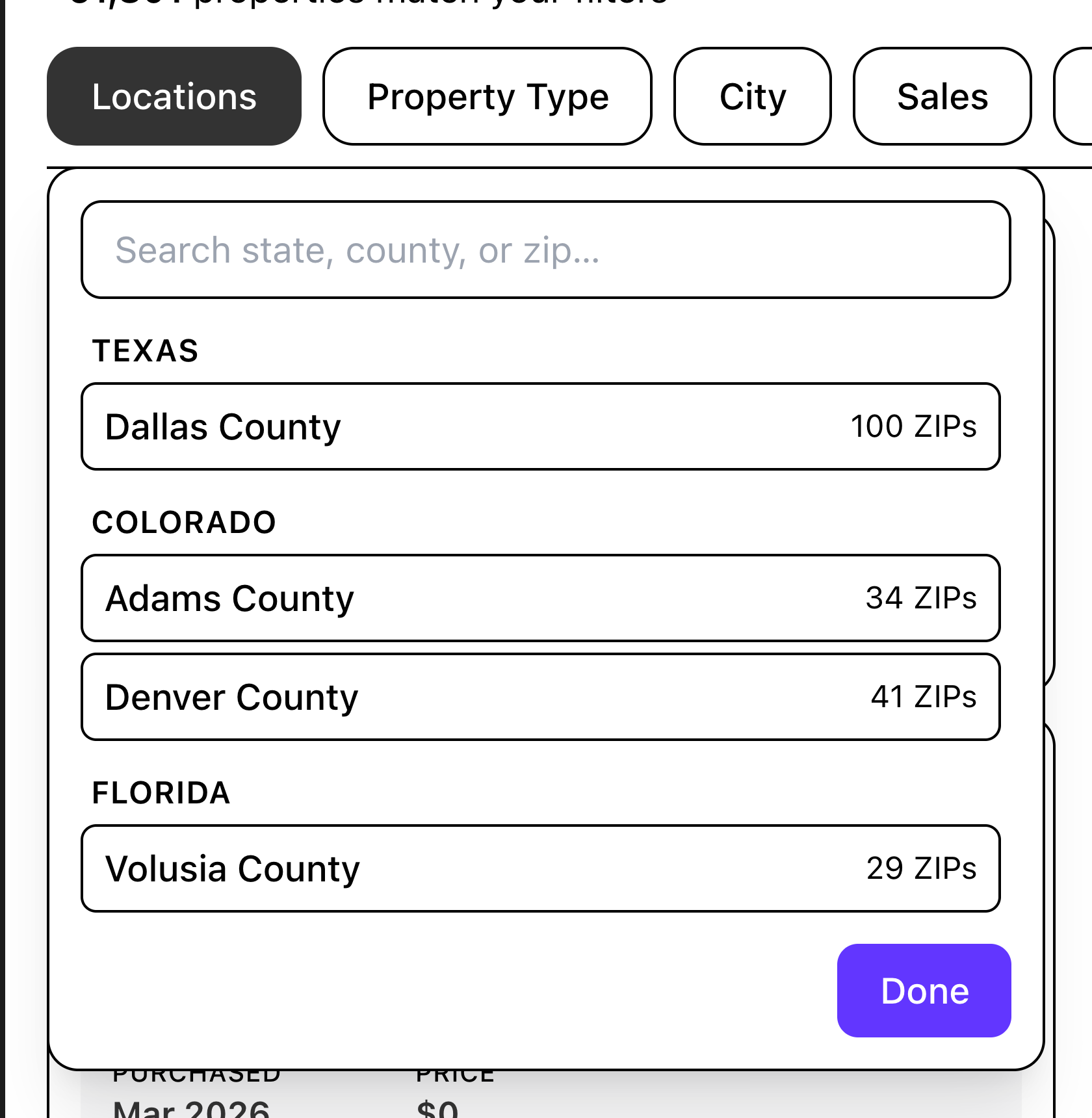
A state, county and ZIP tree under one search box.
Coverage in Agreedment is bought by location and counties can be swapped as your focus moves, which is the honest shape of this problem — nobody works fifty counties at once.
4. What counts as "active"?
Ask for the definition, because there is no standard one.
Some lists count anyone who ever bought. Some count a purchase in the last five years. Some count one in the last twelve months. All three get advertised as active buyers and they are not the same list.
Recency is the whole thing. In markets where this is visible, a meaningful share of all investor purchases happened in just the last twelve months — in some suburbs it runs over 40% of everything on the books. The recently-active subset is a genuinely different and much smaller group than the full one, and it is the group worth calling.
The filter that matters is Activity Status set to Active, in the Investor panel: investors who have bought recently and are still transacting. Pair it with Has Phone under Data Available and click Apply, and the count under the Dashboard title updates to the people you can actually reach today.
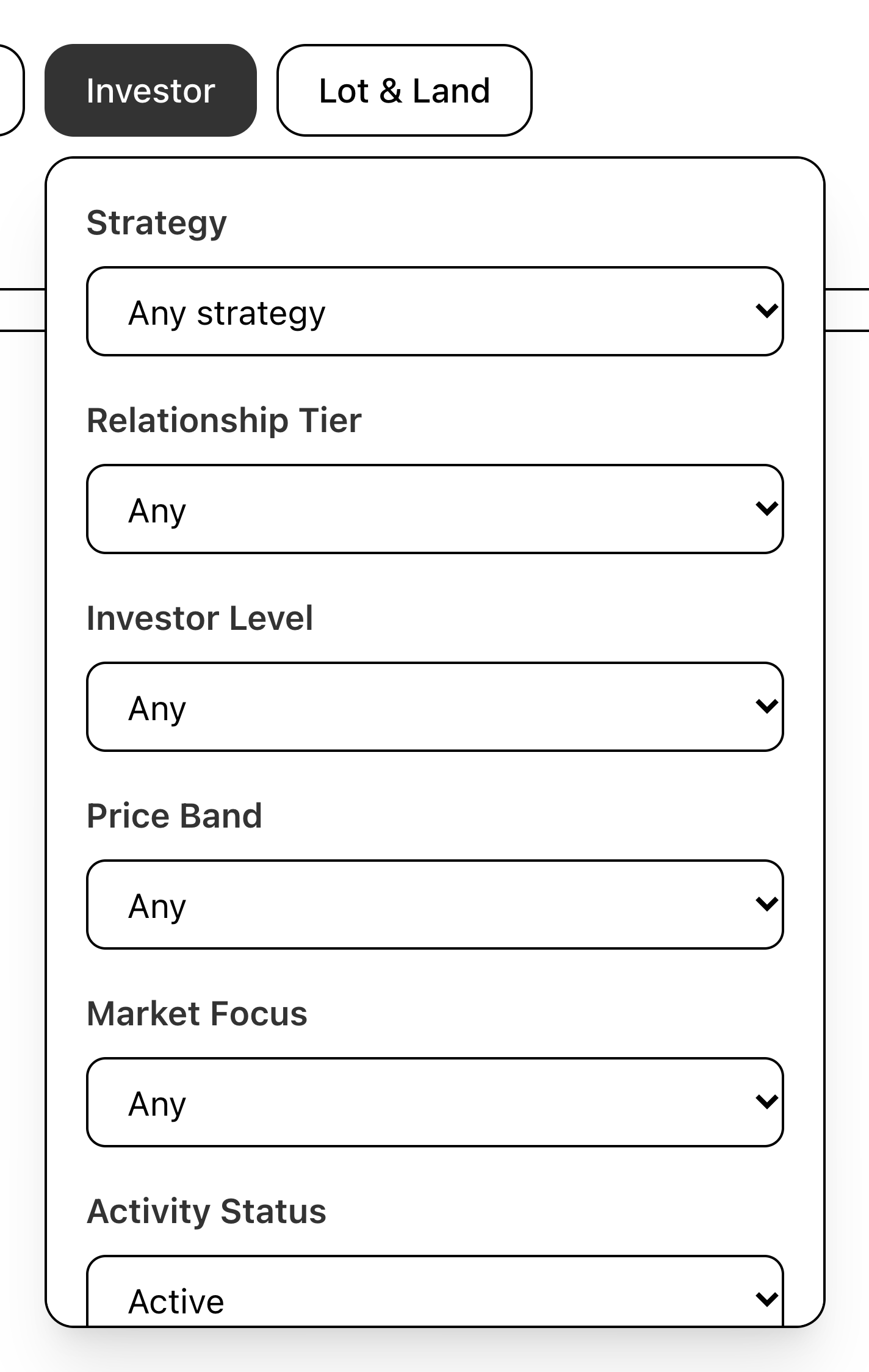
Activity Status separates investors still buying from those who have gone quiet.
A vendor whose "active" cannot be narrowed is selling you the full list with a better adjective.
5. Can you filter by what they buy?
A list you cannot filter is a list you have to read.
Buyers have a buy box whether or not anyone wrote it down — a price range, a property type, a condition they will take, areas they go to. The entire point of having data is matching a contract to the buyers whose box it fits, instead of calling everyone alphabetically and hoping.
So: can you sort by price range? By strategy, meaning rehab versus hold versus build? By property type? If the answer is no, you have not bought a buyers list. You have bought a phone book, and you will do the matching by hand on every deal, forever.
What a good list looks like in practice
Put plainly, the version worth paying for lets you answer one question quickly: given this specific contract, who are the ten people most likely to take it?
Ten good names beats a thousand unverified ones. A thousand names is a month of dialing and a conversion rate you stop tracking because it is depressing. Ten buyers who have each closed something similar in the last year is an afternoon.
That is also the honest test of any data product in this space, ours included. If it does not shorten the distance between "I have this under contract" and "here are the people to call," it is a subscription rather than a tool.
Check the free version before you pay anyone
Before buying from anybody, it is worth seeing what a market looks like from outside. The public market pages show investor counts, how many properties they hold, and roughly what they pay, by county and city, with no account.
That will not give you names — those are the paid side, and the contact details there come from verified property records rather than skip tracing. But it will tell you whether the market you are working has enough active buyers to assign into, which is worth knowing before you buy a list of them.
And if a vendor's numbers for your county look wildly different from what the public data shows, that is worth a question too.


