
The Problem: Wrong Buyers, Wasted Calls
You have a contract. The deal fits your target area and your numbers work. So you start calling buyers—and most of them pass without even asking a question.
The instinct is familiar: "I'll reach out to everyone and see who bites." It feels efficient until you realize you're spending the first thirty seconds of every call explaining why this deal is not what that buyer actually buys. You hear "That's not my type of property" or "Price is too high for that area" and you know the rejection came before you even started.
The waste is not just time. Every pass is a lost callback opportunity. Worse, it trains that buyer to skip your calls altogether.
Why Buyer Lists Alone Do Not Cut It
Having a list of cash buyers in your market is a start. But a list without context is just a phone book—it tells you who exists, not who would actually want this deal.
A buyer who flips single-family homes in one ZIP code is not the same buyer who owns duplexes and triplexes across three counties. A buyer who closes five deals a year at $150k purchases is not going to be interested in $500k properties. Yet if all you have is names and numbers, you have no way to know the difference until the call goes cold.
The common workaround is to call a bunch of buyers and take the first "yes." It works eventually, but it costs you assignments you could have placed faster, and it leaves money on the table when you do not know whether a buyer who wants your deal is looking for a $10k assignment fee or a $30k one.
The Answer: The Buyer's Buy Box
Every serious cash buyer has a buy box—an actual pattern in what they purchase. It is not something they hide. It is visible in the properties they own, the prices they pay, the property types they focus on, and the areas they work.
A buy box has shape: a range of purchase prices, a preference for certain property types (single-family, duplex, apartment, land), a target number of bedrooms and bathrooms, specific counties or ZIPs, and even a strategy preference (fix-and-flip versus hold-and-rent). When you look at a buyer's actual portfolio and recent deal frequency, you can read all of it.
The move is simple: before you dial, check whether this deal fits their box, not just yours. Does the property type match? Is the price in their range? Are the beds and baths typical for what they buy? Is it in a county where they already own? If the answer is yes on all of it, the call starts differently—they already know they want properties like this, and now you're offering them one.
How to Read a Buyer's Buy Box
The data lives in two places: the buyer's portfolio (what they have already bought) and the buy box itself (what they are explicitly looking for).
Start with the portfolio. If a buyer owns five single-family homes between $150k and $200k in the same two counties, all bought in the last eighteen months, that is the clearest signal in the market. You can trust that pattern more than almost anything they might say they buy, because action does not lie.
Look at the property types: are they all residential, or do they mix in commercial or land? Are they all single-family, or do they have multi-unit? Look at the purchase prices: is there a tight cluster, or a wide spread? Wide spread usually means either they are scaling, or they work multiple strategies. Look at the dates: are the deals old or recent? Old deals mean they might be dormant. Recent deals with consistent frequency mean they are actively buying right now. Look at the counties: do they stay in one area, or do they work a territory? That tells you whether this deal's location is a dealbreaker or irrelevant.
Then look at the buy box itself—the explicit criteria they have set. It is usually more conservative than the portfolio (because the portfolio includes the deals they got excited about). The buy box is what they commit to. If your deal sits inside it, the buyer has already decided they want properties like this.
Matching Your Contract to the Buy Box: The Workflow
The point of doing this before you call is speed and precision. You are not hunting for one buyer who might say yes to anything—you are finding the buyers for whom this deal is exactly what they want.
To find buyers whose buy box matches your contract, start by scoping your search to the county your deal is in.
- Click the Locations pill.
- Type a state, county or ZIP into Search state, county, or zip....
- Drill down state, then county, then ZIP. Click 100 ZIPs to expand a county and Hide to collapse it.
- Clicking a county filters to it straight away -- no Apply needed.
 Search, then click the county to scope everything to it.
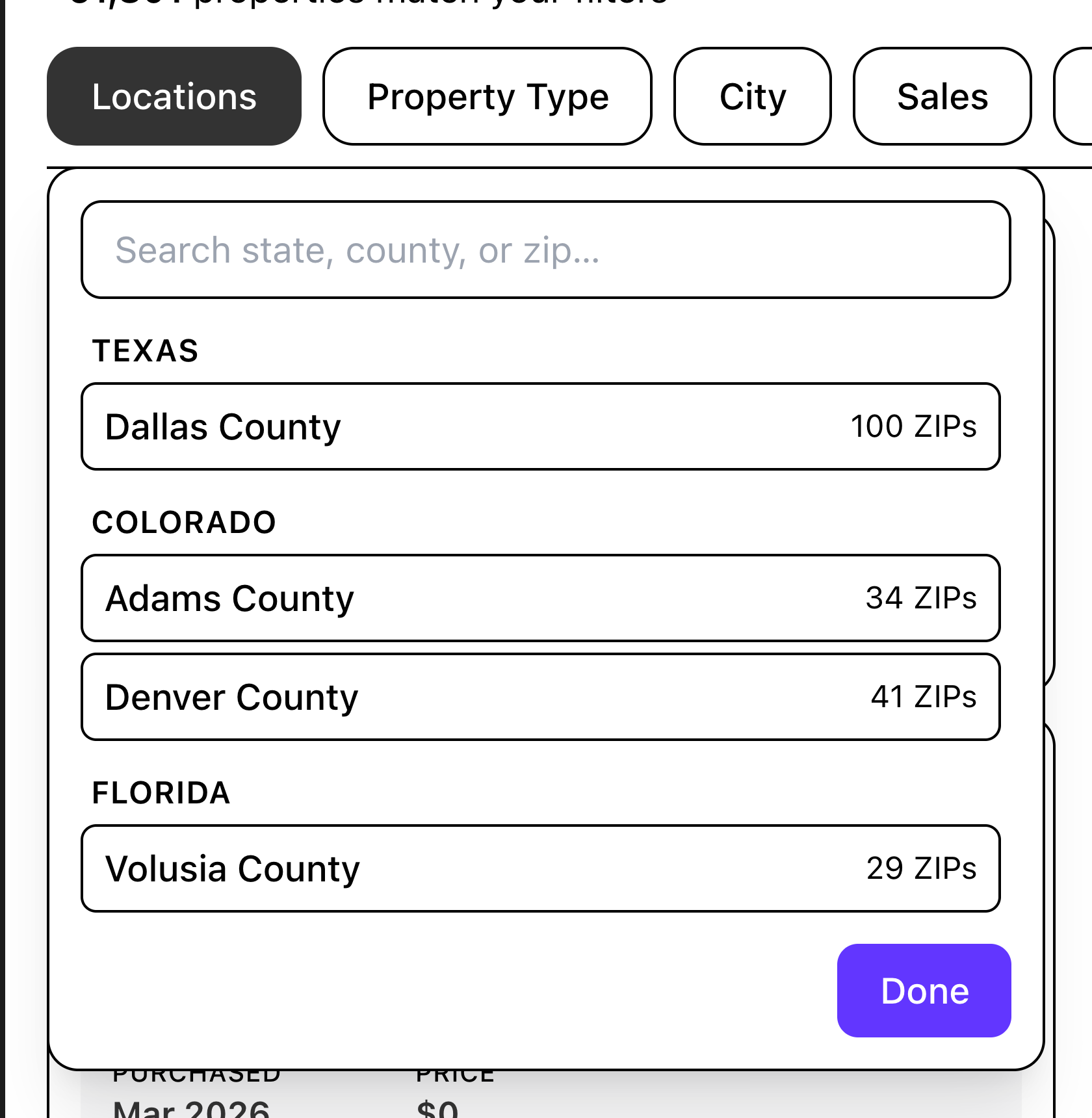 A state, county and ZIP tree under one search box.
Next, filter to investors who are actively buying right now—not historical buyers or those cooling off.
- Open the Dashboard. The count under the title is how many properties match your filters; with none set, that is your whole coverage area.
- Click the Investor pill in the filter bar. This panel describes the owner, not the building.
- Under Activity Status, choose Active -- investors who have bought recently and are still transacting.
- Scroll to Data Available and click Has Phone.
- Click Apply. Your filters appear as removable chips under the toolbar and the count updates.
 The whole flow: Investor, Activity Status, Has Phone, Apply.
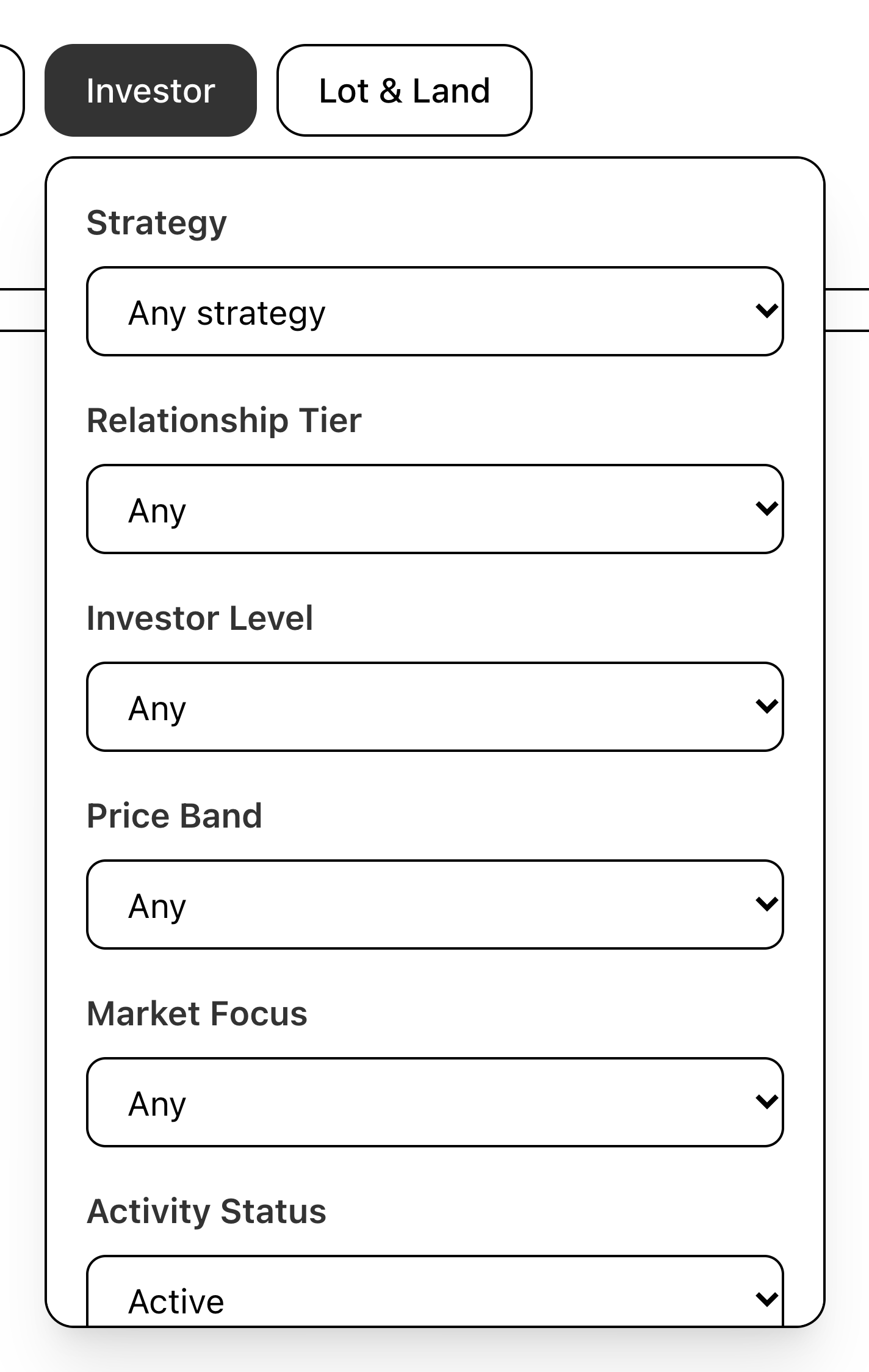 Activity Status separates investors still buying from those who have gone quiet.
Now narrow down by the physical specs of your property. If your deal is a three-bedroom, two-bath single-family home, filter for buyers whose purchases match that profile.
- Click the Building pill.
- Set min and max on any of eight pairs: Bedrooms, Bathrooms, Number of Stories, Total Units, Total Buildings, Building Area, Half Bath, Total Rooms.
- Return both to Select to clear.
The result is a list of active investors in your county whose recent purchases look like your contract. Open their profiles and scan the portfolio to verify the pattern—price range, property type, frequency, and any notes on strategy. Read the buy box fields. If they match your deal, this buyer is a real prospect. If they do not, move down the list.
What This Changes on the Phone
When you call a buyer whose buy box actually fits your deal, the conversation starts in a different place.
You do not open with "I have a property I think you might like." You say, "I have a three-bed, two-bath in [ZIP code] in the [price range]. It looks like your typical deal. When can you see it?" The buyer already knows they want properties that match that description because they have bought several. You are not selling them on the property type or the area—you are offering them another deal inside the box they have already committed to.
This does two things. First, it gets past the objection phase fast. If the deal truly fits, there is no "That's too high" call because you did not pitch them something outside their range. Second, it opens the conversation to the real negotiation—what the assignment fee should be. That is a conversation worth having. A conversation about whether they even buy in your area is time neither of you should spend.
On the next call or deal, before you dial anyone, spend five minutes filtering to buyers whose portfolios show they buy what you have. You will close faster and at better fees because you are calling people for whom this is the deal they are actually looking for.


