
The Problem: You Are Calling the Wrong People
You have a contract. You need a buyer. So you call down a list of investors you haven't worked with—or worse, a list you bought—and dial until someone picks up. Most don't. The ones who do say "That's too high" or "Not my market" before you finish your pitch. By the end of the day, you have burned twenty calls for one callback, and assignment time is gone.
The problem is not your pitch. It is that you are calling investors who are not actually buying right now, or who do not buy deals like the one you have. A long list of names is not a sales tool; it is noise. You need a short list of the right people, filtered to where they are actually transacting and what they actually buy.
Why Your Current List Fails
Most buyer lists share the same flaw: they lump all investors together, ordered by tenure or lifetime deal count. An investor who closed ten deals over eight years and then stopped is ranked the same as one closing two a month. A buyer who specializes in multi-family sits on the same list as the single-family flipper, undifferentiated.
You end up calling investors who have gone quiet, who have moved markets, or whose buy box never included your property type or price range. Each call wastes five minutes and costs you one more failure in the callback rate.
Worst, you have no proof of what these investors actually buy. You can see their stated preferences, but not the deals they've really paid for. A buyer claims they flip single-family homes—and they may have bought five multi-family buildings last year. You call about a single-family assignment and hear "Not my focus."
What to Look For Instead: Activity and Acquisition History
An investor's callback rate rises sharply when you call someone who has bought in the last three to six months and whose recent purchases match your contract. Activity is measurable. Recent deals are a fact.
Start by narrowing to investors with recent acquisitions. Not investors who could buy, but investors who have bought lately. Then cross-check those recent deals against your contract: price, property type, location. If they bought three single-family homes in the ZIP next to yours in the last four months, they are a far better call than an investor with more deals on paper who has not bought anything in a year.
This approach does two things. First, it proves the investor is active and their buy box is real—you are not calling a ghost lead. Second, it lets you reference their recent purchases on the call itself. "I saw you closed on Oak Street last quarter; this deal has the same profile" is vastly stronger than hoping they remember their own stated criteria.
How to Build This List in Agreedment
Narrowing to active buyers with contact information takes three filter moves.
First, scope to your county or ZIP.
- Click the Locations pill.
- Type your county or ZIP into Search state, county, or zip....
- Click the county to filter to it. (Drilling into ZIPs lets you see the breakdown; clicking a county filters everything at that level.)
 Search, then click the county to scope everything to it.
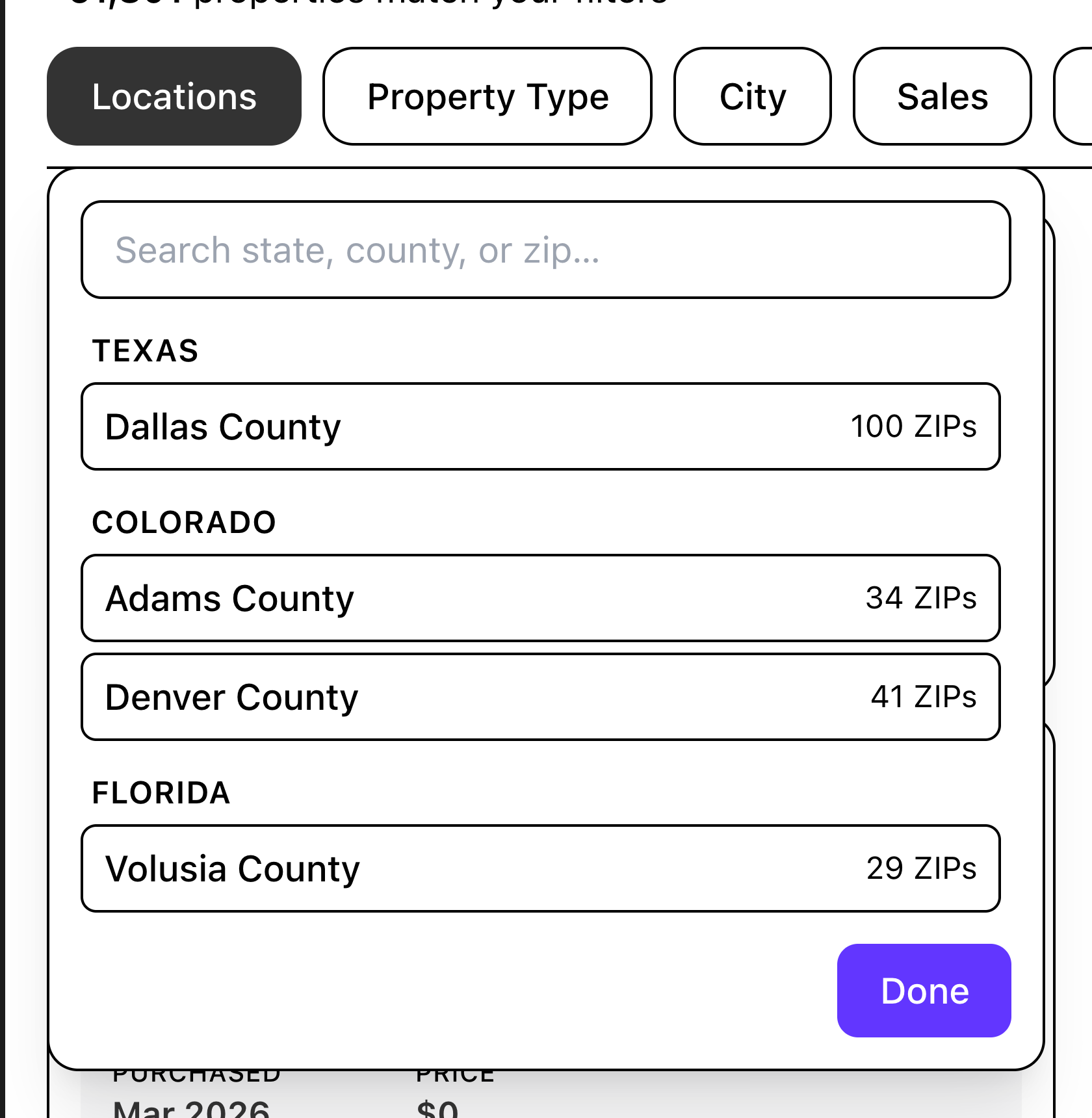 A state, county and ZIP tree under one search box.
Now filter to investors who are buying right now and can be reached by phone.
- Click the Investor pill. This panel describes the owner—the person who controls the buying decision—not the property itself.
- Under Activity Status, choose Active. This isolates investors with recent acquisitions and ongoing deal velocity.
- Scroll down to Data Available and click Has Phone. You now have phone numbers, not just names on a list you cannot call.
- Click Apply. Your filters appear as chips below the toolbar, and the count updates to show how many buyers meet these criteria.
 The whole flow: Investor, Activity Status, Has Phone, Apply.
 Activity Status separates investors still buying from those who have gone quiet.
This short list is now your actual call sheet. Every name on it has bought something recently and can be reached. You have moved from spray and pray to targeted dials.
Match Your Contract to What They Actually Buy
Before you dial, drill into each buyer's portfolio. Look at their recent deals—not their words, but the addresses they bought and what they paid. Does the price match? The property type? The location? If you have a single-family contract for $140K in the northwest part of the county, and the investor's three most recent buys are multi-family apartments in the south side, you can skip them. You will hear "Not my market" before you finish talking.
If their last five acquisitions are all single-family homes in the $130K–$160K range in your ZIP or the adjacent one, you have found the right call. Reference it when you reach them: "I saw you bought the Johnson Street property last quarter; this deal has the same profile and the same price point." You are not calling cold anymore. You are calling with proof that they want what you have.
When to Make the Call
Timing matters, but not the way most wholesalers think. You do not need to call the second a deal comes available. You need to call when you know the buyer is active enough to close soon, and when you are ready to answer specifics about your contract.
Active investors get multiple offers a week. If you call without a signed contract or proof of funds from your seller, you are noise again. Call when you have the paperwork clean, the ARV backed by comps, and the repair estimates real. A buyer with deal velocity moves fast when the package is tight.
Second, call outside the chaos hours. Early morning or late afternoon tends to work better than 10 a.m. when a buyer is running a crew. A quick voicemail with your numbers—price, property type, location, your fee—is fine. If they are interested, they call back. If you leave a rambling message with no specifics, you won't hear from them.
Third, follow up at least twice. The first call may land when they are doing payroll. The second, a day or two later, lands when they are between jobs. Do not spam; three calls over a week is reasonable. After that, move on.
What to Actually Say
You have thirty seconds before they screen to voicemail. Use that time to answer three things: what, where, and how much.
"Hi [Name], this is [Your Name]. I have a single-family in Riverside, $135K contract price, good bones, 30-day close window. I saw you bought on Maple Street last quarter—this one's in the same ZIP with a similar profile. My fee is [amount]. Give me a call back at [number]."
That is it. You named the property type (they know whether they buy it), the location (they know if they work that ZIP), the price (they can do math), and the fee (they know if it makes sense). You also proved you did homework: you mentioned their recent deal. This is not a cold call; it is an informed outreach.
If they pick up, stop selling. Ask one question: "Do you have time for ten seconds?" If yes, give them the same thirty-second summary. Then shut up and listen. They will tell you yes, no, or ask a question. Answer the question; do not keep pitching. The investor who bought three in your ZIP is already convinced your market is worth their time. You are just confirming the deal makes sense.
If they say "Send me something," send the contract, repair estimate, and comps as one PDF. Do not send a portfolio or a list of other deals. They do not have time to read it. One deal at a time.
Build the Habit
Doing this three times—scoping to a county, filtering to active investors with phone numbers, cross-checking their recent deals against your contract—takes less than five minutes. The old method of calling through a generic list until someone sticks around for a pitch takes an hour and produces fewer callbacks. Pick the faster way, and make it a rule before you dial. Contract first, then check the list, then call.
You will find yourself talking to people who are actually buying, in your market, right now. They have money to move and a real need for your deal. Callbacks rise, assignment fees land, and you stop burning calls on people who will never say yes.


