
The Wasted Call Problem
You've got a contract. You pull up a list of cash buyers in the market, find one who did deals last year, dial the number, and pitch the property. They hear your price and say no. You move to the next name.
The call felt wasted because it was. The buyer wasn't shopping for what you had. They were never going to say yes at your price, in your ZIP, for that property type. You didn't know that before you dialed, so you spent the capital on a call that had no chance.
This happens because most wholesalers build a buyer list without ever looking at what those buyers actually purchase. A name and a phone number tell you nothing about fit. A buy box does.
Why the Usual Approach Fails
The standard move is to call every buyer and ask "What are you looking for?" That works if you have unlimited time and the buyer answers honestly. But a busy investor gets dozens of calls a week, and by the time they tell you their price range and property preference, the conversation has cost them and you.
Worse: what they say they buy and what they actually buy are often different things. A buyer might tell you they work the whole county when their last five deals were all in one ZIP. They might say they buy anything when the data shows they exclusively buy single-family homes under a certain size. The gap between stated preference and actual purchase pattern is real, and it kills assignments.
You need to see what they bought before you call.
What a Buy Box Shows You
A buy box is a summary of what an investor has actually purchased: the price range, the property types, the number of beds and baths, the condition they prefer. It is built from their real deal record, not from what they claim to do.
Three things live in that box, and each one tells you whether this buyer is worth calling about your specific deal.
Price range. This is the narrow band where the investor's recent deals clustered. If your contract price sits well below or well above it, the buyer will not move. Not because they are rigid, but because their capital, their strategy, and their exit path are calibrated to that range. A fix-and-flip investor who typically buys at $180,000 to $220,000 is not going to pay $280,000 for your deal, even if the numbers work on paper. Their model does not. And they know it better than you do.
Property type. An investor who has closed a dozen deals on duplexes and triplexes is not fishing for single-family homes. An investor focused on multi-family does not want townhouses. This sounds obvious, but most wholesalers skip this check because they assume cash buyers will buy anything. Some will, but the ones making consistent offers and closing fast have a type preference, and it shows in their portfolio.
Unit count and size. The number of beds and baths, or the total square footage, signals the investor's target market and their rehab appetite. A buyer who closes properties in the three-to-five-bedroom range is unlikely to move on a two-bedroom, even if the price fits. They have contractors, a team, and a market positioning built around a specific size. Asking them to step outside it is asking them to operate outside their system.
Together, these three filters answer a single question before you pick up the phone: Is this buyer built to buy this property?
How to Read the Buy Box in Practice
When you look at an investor's buy box on their profile, you are seeing aggregated data from their closed deals. The price range represents where most of their purchases landed. The property types show what dominated their portfolio. The bed and bath counts show their typical unit profile.
This is not a wish list. It is a record of what they have actually done, repeatedly, with real capital.
The power is in the specificity. If your contract is a four-bedroom single-family home at a given price, and the buyer's portfolio shows they buy three-bedroom duplexes at a lower price point, you already know the answer. You do not need to call. You can move down your list to the buyer whose box matches your deal, or you can go back to the seller and reset expectations.
This saves time on both ends. The investor does not get a call about property they will not buy. You do not waste a dial on a long shot.
You also go into every call with more credibility. When you call a buyer and reference their recent purchase in a comparable property at a price that matches your deal, they hear someone who has done homework. That person is worth listening to.
Finding the Right Buyer for Your Deal
Inside Agreedment, every investor's buy box is built from their acquisition history and is visible in their profile. You can filter by the exact attributes that matter for your contract.
Start by matching the core deal parameters. If your property is a single-family home, filter to investors who predominantly buy single-family homes.
- Click the Property Type pill.
- Select Single Family from the menu.
- Choose Any type to clear the filter.
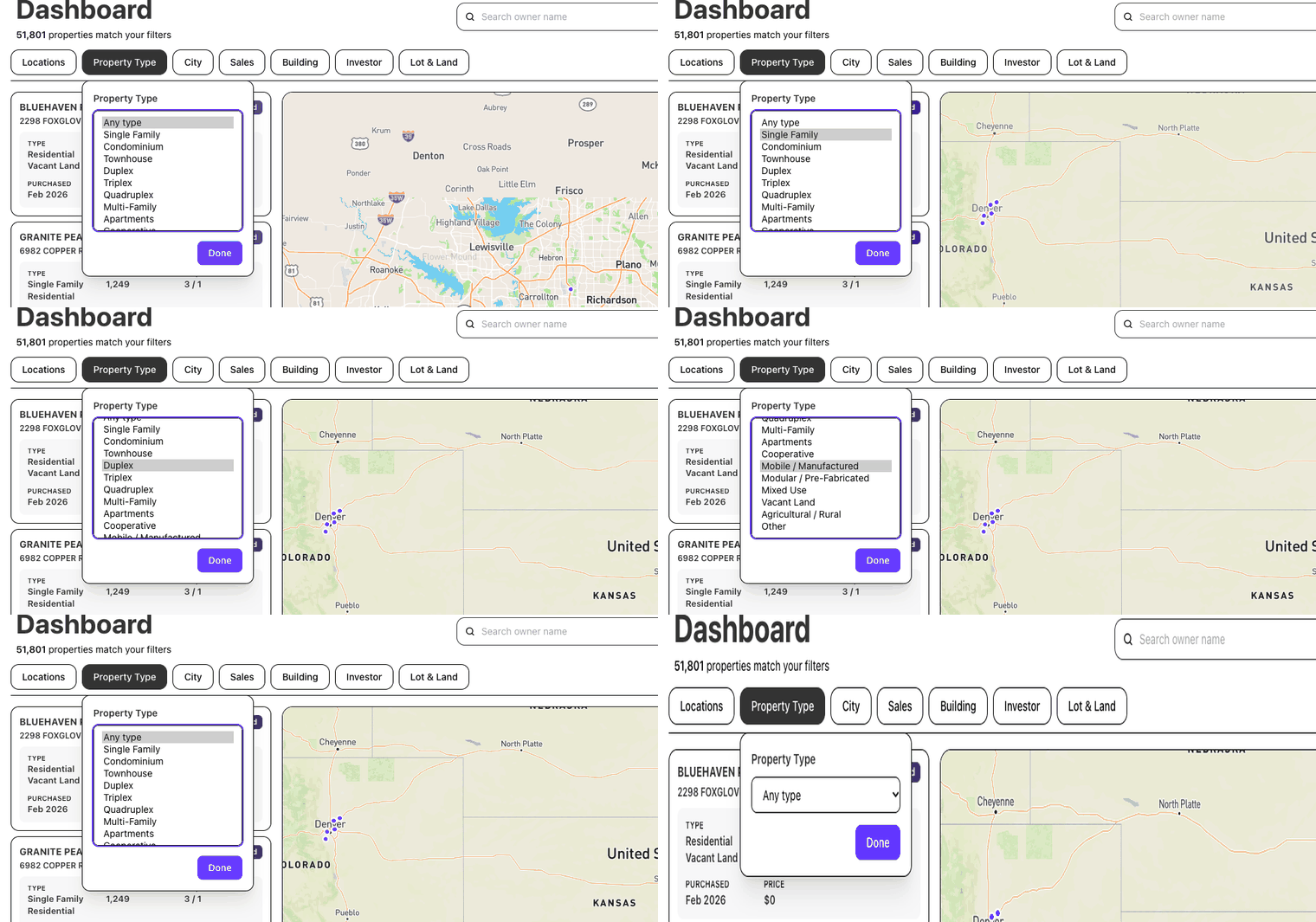 Every property class in one menu.
 Any type removes the filter.
Next, narrow by the physical attributes. If your deal has four bedrooms and two bathrooms, filter to properties in that range so you see investors whose portfolio matches the unit type you have under contract.
- Click the Building pill.
- Set minimum and maximum on Bedrooms and Bathrooms to match your property.
- Return both to Select to clear the filter.
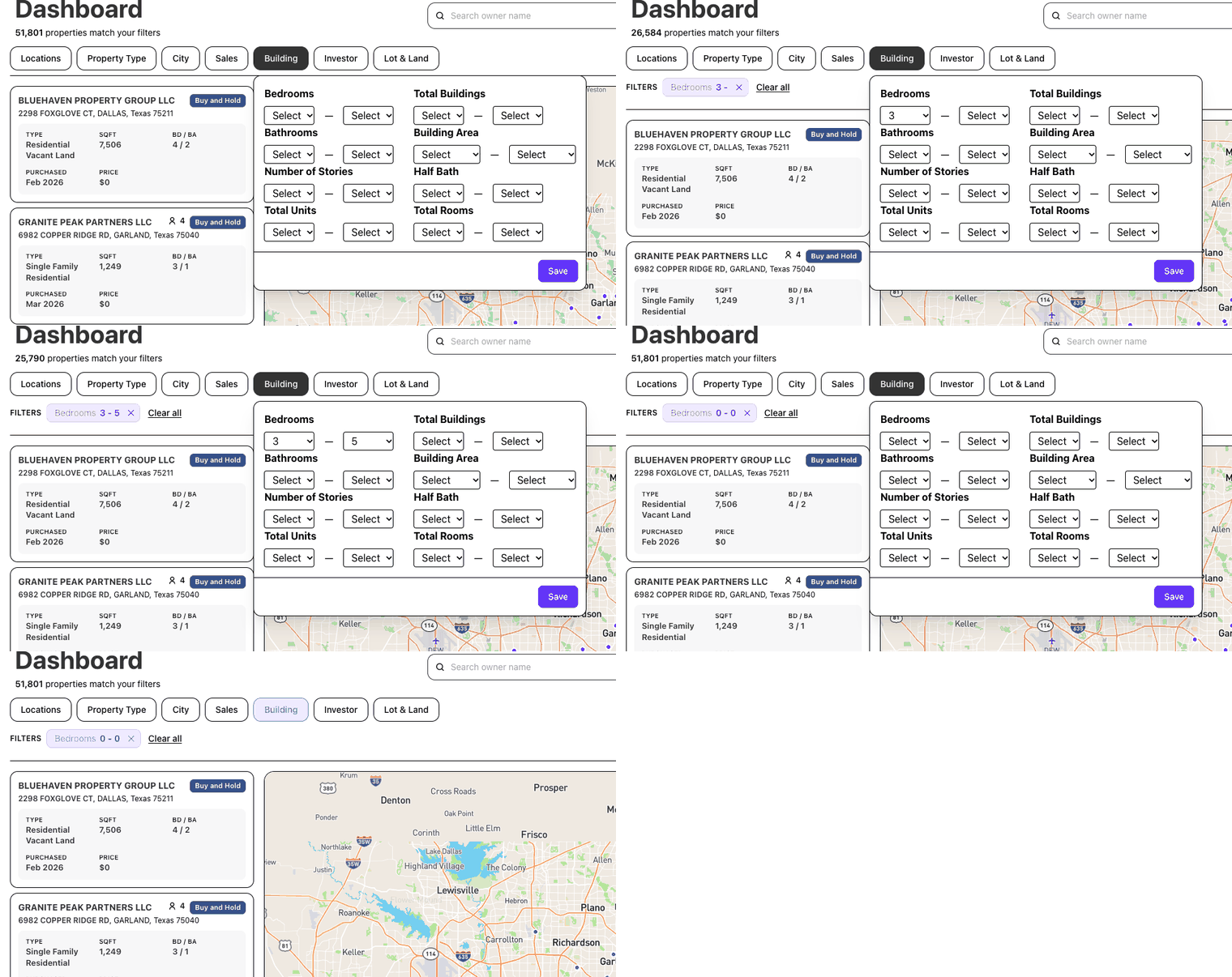 Eight min/max ranges describe the building.
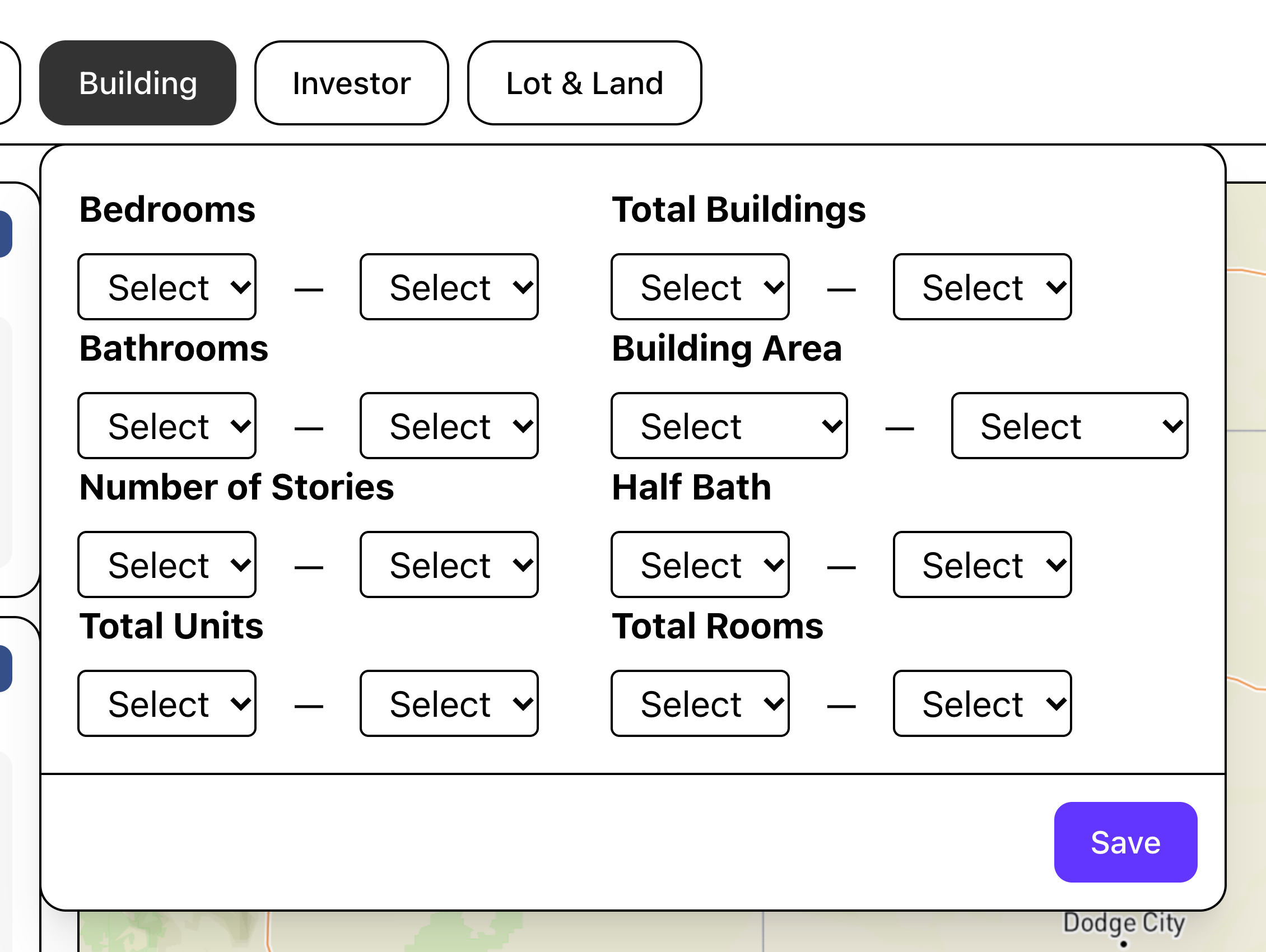 The Building panel.
Now set the price band. This is the critical filter. You want to see investors whose purchase price aligns with where you expect to assign the deal. Look at what they have actually paid, then make sure your deal lands in that zone.
- Click the Sales pill.
- Set minimum and maximum on Purchase Price to your target assignment band.
- Return both ends to Select to clear.
What you see now is a list of investors who have bought deals matching your property's profile. Every name in this list has a buy box that contains a property like yours. You are no longer calling blind.
What Happens Next
Once you have filtered to buyers whose box fits your deal, the call changes. You are not asking if they buy single-family homes or what price they pay. You already know both. You can reference their recent acquisition, note that your deal is in their wheelhouse, and move straight to the specific property and the specific terms.
If they are interested, the conversation will move faster because there is already alignment. If they are not interested, you know it is not because your property type is wrong or your price is too far outside their model. It is because of a factor specific to this deal—the location, the condition, the timeline—and you can either address it or move to the next buyer who is more likely to say yes.
This is not a guarantee of a deal. But a buy box is a filter for probability. It separates the calls worth making from the ones that are noise, and it lets you spend your dialing capital on buyers who are actually built to close your assignment.


