Who Is Buying in 33852 (Lake Placid)
Investor purchase activity, drawn from the last 12 months of records.
Data last updated
In Lake Placid (33852), investors own about 2,199 tracked properties across 143 active buyers, with a median investor purchase price near $11,000. 423 were acquired in the last 12 months.
Acquisition Activity
Property Characteristics
Investment Strategy Mix
Hottest ZIP codes for investors
What the 33852 numbers mean
How much buying is happening in 33852
Typical deal size in 33852 sits around $11,000. An average of $111,000 against that median means a handful of large purchases are skewing the mean. Use the median when you price, or you will aim high and lose the middle of the market.
143 cash buyers are active in 33852, and between them they hold about 2,199 properties. Fewer than 3.0 purchases per buyer over the past year means buying is thinly spread, so breadth of outreach matters more than any one contact.
Investors bought 423 properties here over 12 months, up roughly 13% from about 373 a year earlier. Rising volume usually means capital returning to the market rather than leaving it.
Roughly 19.2% of what investors hold here changed hands in the past year. That is a fast-cycling market: positions here are short, and a buyer who passed last quarter may be back this one.
How 33852 compares with the rest of Highlands County
Within Highlands County, ZIP 33852 ranks 2nd of 8 ZIP codes on investor purchases, with 423 over the last year. That is about 4.1× the 102 logged by a typical ZIP code in the county. Put another way, 15% of the county's investor deals in the last year happened here.
ZIP 33852 is lagging the county. Purchases here are up 13% on the year while Highlands County is up 106%, so buyers are finding deals elsewhere.
If you like ZIP 33852, look at 33875 in Sebring next — similar volume (117 deals) and similar pricing ($23,000). 33872 in Sebring tops Highlands County with 1,993 purchases — many of the county's most active buyers will be working there too.
ZIP 33852 is a value market by county standards: its $11,000 median runs 76% below the $45,000 typical of other ZIP codes. Nowhere else we track in the county is cheaper; the next step up is 33857 in Lorida at $23,000.
| ZIP code | Active buyers | Purchases (12 mo) | Year over year | Median price |
|---|---|---|---|---|
| 33872 (Sebring) | 132 | 1,993 | +241% | $407,000 |
| 33852 (Lake Placid)(this page) | 143 | 423 | +13% | $11,000 |
| 33825 (Avon Park) | 77 | 136 | +24% | $45,000 |
| 33875 (Sebring) | 86 | 117 | +10% | $23,000 |
| 33870 (Sebring) | 77 | 102 | -11% | $73,000 |
| 33876 (Sebring) | 47 | 54 | +17% | $11,000 |
| 33857 (Lorida) | 10 | 12 | +200% | $23,000 |
| 33960 (Venus) | 5 | 1 | -92% | $50,000 |
How 33852 looks to a buyer, a wholesaler and an owner
The owner's view in 33852 sits in between: enough investor interest that an unsolicited offer is not startling, not enough that it is background noise. A specific, well-supported approach tends to get a real hearing here.
With a median near $11,000, many purchases here are within reach of a buyer's own cash, which removes the lender from the transaction entirely. Those deals close fastest of all, and the buyer's only real constraint is how many they can manage at once. Turnover in the middle of the range points to mixed exits: some buyers resell inside a year, others hold through it. That ambiguity is worth resolving per buyer rather than assuming, because the two types value the same property differently.
Spread across the year, 423 purchases works out to roughly 35 a month in 33852. That cadence is the useful planning number: it tells you how many opportunities realistically exist in a given month, and therefore how much of your pipeline this one market can carry.
The typical 33852 buyer is holding ground, not operating a property, so speed matters less here than basis. At $11,000, buyer intent matters more than price. The number alone does not tell you whether you are talking to renovation money or hold money, and those two want opposite things.
At roughly 19% of investor stock trading per year, 33852 is a middling market on movement: workable, without the tailwind a hotter area gives you. A pool of 143 buyers is deep enough that indiscriminate outreach wastes most of the effort. The leverage is in segmentation — matching a contract to the handful of buyers whose record says yes.
At roughly 3.0 deals per buyer, this is a balanced market. Buyers are active enough to be real and not so active that they can afford to be dismissive. Land-heavy markets see less wholesaler competition, because land requires a different conversation. That is a moat for anyone willing to learn the entitlement side.
Working a deal in 33852
If you are wholesaling in 33852, a contract priced between $9,000 and $13,000 sits inside the band where most investor money already moves. Start with the 15 most active buyers; at this level of repeat buying they will see most of what is worth seeing. In a market picking up like this one, the first credible offer often wins, so respond the same day.
There is also a valuation trap. The average purchase runs well above the median here, which means a handful of outsized deals are inflating the mean — and anyone pricing a contract off the average will set a number no typical buyer in 33852 will meet. The median is the honest anchor; the average describes transactions you are probably not part of. These numbers describe completed, recorded transactions. That makes them solid ground for strategy and a poor instrument for timing, since the most recent weeks are always underrepresented.
For outreach, there are 271 contact records tied to buyers in 33852 inside the platform — more than one per active buyer.
If 33852 is new to you, the first move is narrowing rather than broadening: build a shortlist of roughly 22 buyers whose recorded purchases match the kind of property you can actually source, and learn those names properly before widening. A small list worked well outperforms a long one worked thinly, and the data to build it already exists in the purchase record. Third, plan for a longer cycle. With stock moving slowly, expect weeks rather than days between a contract and a committed buyer, and price the assignment so that patience is affordable. A fee that only works on a fast close will not survive this market.
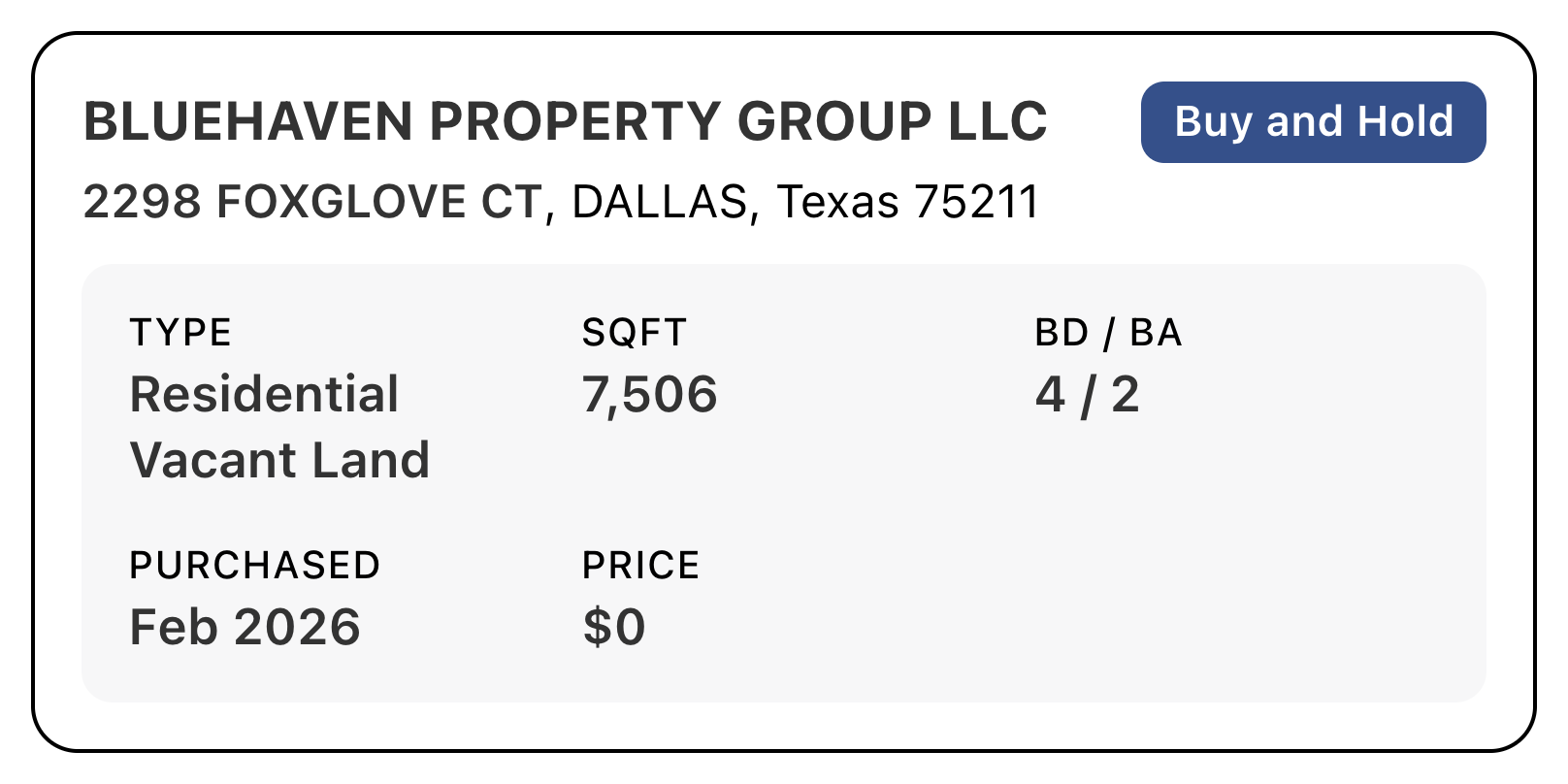
The properties behind the numbers
By count, residential vacant land top the list of investor purchases in 33852.
Strategy here skews to buy & hold, which accounts for 100.0% of tracked deals. Buy-and-hold capital prices for yield rather than resale margin, so rent support matters more to these buyers than after-repair comps.
Behind the leading strategy sits new construction (0.0%) and value-add / rehab (0.0%), so a deal that misses the main buyer profile still has somewhere to go.
All figures above reflect recorded transactions in this ZIP code and update as records are processed. Past activity only — nothing here is a forecast or investment advice.
Popular searches around 33852
Common questions
- How many investors are active in Lake Placid?
- There are 143 active investors owning 2,199 tracked properties in Lake Placid.
- What is the median investor purchase price in Lake Placid?
- The median investor purchase price is about $11,000 in Lake Placid.
- How active is the Lake Placid investor market recently?
- 423 properties were acquired by investors in the last 12 months in Lake Placid.
- Is there recent new-construction investor activity in Lake Placid?
- 0 new-construction homes were acquired by investors in Lake Placid in the last 90 days.