
The Problem You've Already Hit
You pull a list of cash buyers in your market. You dial the first ten numbers. Three go to voicemail. Two say they're not buying right now. Two more take the call but aren't interested in your deal. One hangs up. The remaining two sound interested—you're on the phone for forty minutes with them, send comps, follow up twice, and hear nothing back.
Then you wonder: were those buyers ever actually active, or did you just waste an hour of calls on someone who quit buying last year?
This is the core frustration of working from a static buyer list. A name and a phone number tell you who was a cash buyer. They do not tell you who is one right now.
Why "Years Active" Alone Misleads You
Wholesalers often lean on tenure as a proxy for reliability. A buyer with five years of experience sounds more legit than one with two. But tenure is a trap. Someone can be active for ten years and dormant for the last eighteen months. The length of their career tells you nothing about whether they have capital right now, whether their strategy still fits your deal, or whether they are even taking calls.
The same applies to portfolio size. An investor with fifty properties closed might not have bought anything in two years. Another investor with fifteen properties might have acquired five in the last three months. The static count—years active, total units, lifetime deals—is historical. It answers the question "Has this person ever invested?" not "Are they investing now?"
What matters is the arc: How recently did they buy? How often are they buying? Are they accelerating, steady, or cooling off? That is what separates the call worth taking from the one that eats an hour.
Read the Acquisition Frequency, Not Just the Record Count
The buyers you want to talk to first are the ones buying recently and buying often. This means looking at three specific data points:
Last acquisition date. When was their most recent purchase? A buyer who closed a deal three weeks ago is in motion. A buyer whose last deal was fourteen months ago has either stepped back voluntarily or hit a capital constraint. You might still reach them—cooling-off investors often re-enter—but they are not your first call.
Deal pace over the last year or two. How many properties did they acquire in the most recent twelve months? A buyer doing one deal a year is steady but selective. A buyer doing one deal a month is volume-oriented and capital-heavy. Neither is better—but you need to know which one you are calling, because it changes your pitch. A high-volume buyer might take your assignment if the numbers work; a selective buyer is turning down deals constantly and will be harder to move on price alone.
Activity status—the investor's current thermal state. This is the meta-signal. Based on their actual transaction history, is the investor actively buying, taking a pause (cooling off), coming back after a break (re-entering), or dormant? This is not a guess about their mindset. It is a classification based on what they actually did in the market. An investor marked as re-entering has stopped buying for a while but has recently picked up again—a much better call than a dormant investor, and much fresher than someone you have not spoken to in two years.
These three dimensions together paint a realistic picture. A buyer with two closings in the last year, acquisition date within the past sixty days, and status marked Active is someone you call today. A buyer with five lifetime properties, last deal two years ago, and status Dormant is someone you note for later outreach—or skip entirely if your call list is already deep.
How to Identify Active Buyers in Agreedment
Instead of calling down a static spreadsheet, use your buyer data to filter for the signals that predict a conversation worth having.
- Open the Investor panel in the dashboard.
- Under Activity Status, select Active. This surface investors who have bought recently and are still transacting.
- Scroll to Data Available and click Has Phone. This ensures every name on your list has reachable contact information.
- Click Apply. Your filters appear as removable chips under the toolbar and the property count updates.
 The whole flow: Investor, Activity Status, Has Phone, Apply.
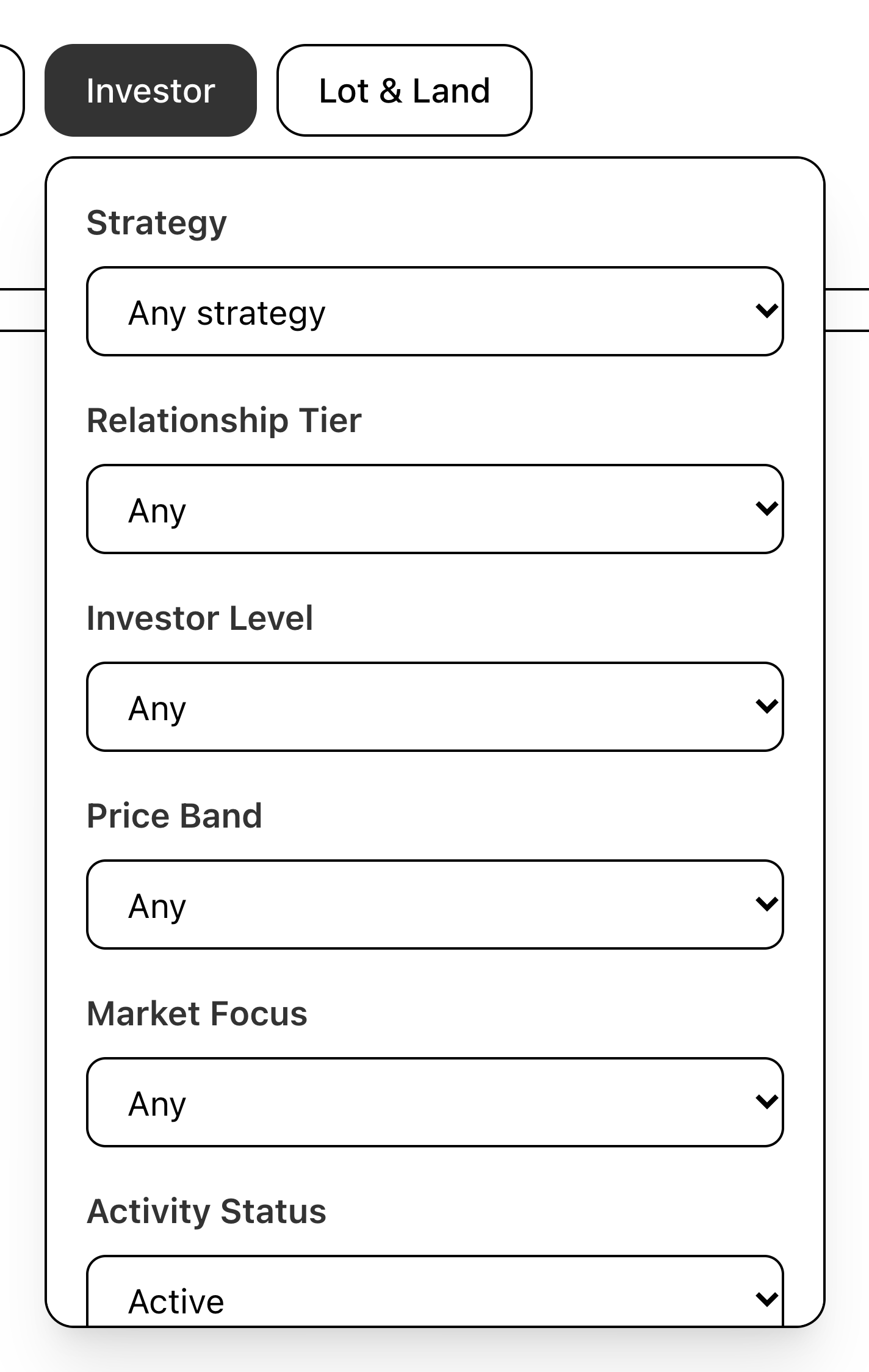 Activity Status separates investors still buying from those who have gone quiet.
What you have now is not "all the investors in the county." It is "the investors who are buying right now." That is a dramatically shorter list—and a dramatically better use of your time.
Use Activity Status as Your Tier-One Signal
Activity Status is the single most useful shortcut because it compresses all three signals above into one classification. Here is how to read it:
Active: Investors currently transacting. Recent acquisitions, typically within the last few months. These are your first calls. They have capital, they are using it, and they are in the mindset of evaluating deals. Expect the highest callback and close rate from this group.
Cooling Off: Investors who were active but have slowed or paused. Useful for tracking, but lower priority than Active. They might be between funding cycles, or they might have intentionally stepped back. When you do reach them, the conversation often centers on re-engaging them. This is fine if your deal is exceptional; it is not a cold call audience if you have better options.
Re-Entering: Investors who went dormant or cooled off, then started buying again. This is a powerful signal. They have proven they can close deals, they have capital access, and they have just signaled they are back in the market. Call them, but frame your outreach as part of their re-entry—"I see you are acquiring again, and I have a deal in your buy box."
Dormant: Investors whose last activity is more than a year or more in the past. Very low near-term callback probability. Keep them in your system for future outreach, but do not spend call time here when Active investors are waiting.
The first two categories—Active and Re-Entering—are your working list for this deal cycle. Cooling Off and Dormant are your prospect pipeline for the next one.
What to Do With Your Active List on the Next Call
Once you have filtered to active buyers with phone numbers, your next move changes. You are no longer qualifying whether someone invests—you know they do. You are qualifying fit: Does their buy box match your deal? Have they worked with wholesalers before? What is their typical hold or flip timeline?
When you dial an active buyer, you can lead with the deal details instead of a soft introduction. "I have a single-family, three-bed, two-bath in the [ZIP], under contract at [price], with an ARV of [amount]. Your portfolio shows you acquire in this area and this price band. Are you actively looking?" This is a relevance check, not a cold prospecting call. The investor already proved they buy in your market, in your property type, and in your price range. You are asking if they want this specific deal.
This saves calls and increases your callback rate, because you are calling investors who are actually buying, and you are offering them something in their known buying pattern. The time you save by not calling dormant investors—or calling Re-Entering investors lower in the priority order—gets spent on multiple active buyers, which increases your odds of assignment.
The buyers who say no to one deal might say yes to the next one from you, but only if they are actively looking when you call. Activity Status tells you that before you dial.

