
The Real Problem With Calling Every Buyer in Your Market
You have a contract. You pull up a buyer list, and it has dozens or hundreds of names on it. So you start calling. Some investors say they don't buy in your area. Some say they do but the price is wrong. Some say they're not active right now. A few might nibble.
The problem is not that the list is bad. The problem is that you are calling everyone.
Every call to an investor who has not bought anything in two years, or whose last five deals were across the state, or whose average purchase is fifty percent higher than your contract, is a call that will not close. You burn through your dial time reaching people who have no reason to say yes, and you pile up rejections that start to feel like market feedback when they are actually just bad targeting.
The fix is not to call fewer people. It is to call the right people: investors actually buying in your market right now, in the price and property type range that matches your deal.
Why "Active Buyer" Means More Than You Think
When a wholesaler thinks of an active buyer, they often mean someone who is still in business, still taking calls, still theoretically buying. That is not the same as someone who is actually buying.
An investor might have closed deals five years ago. They might have told you last year they were still in the market. They might have their website up and their phone line answered. None of that tells you whether they are transacting now.
What tells you is the record: what they actually purchased, when they purchased it, and how often they are still purchasing. An investor who closed three deals in the last twelve months is sending a different signal than one who closed their last deal two years ago. One is active. One is dormant.
This matters because the dormant investor may wake up. But right now, on this call, about this contract, they are not your buyer. Calling them is a courtesy call that uses your time. Calling the active investor is a business call that might close.
What to Look At Before You Dial
When you pull a buyer to call, the first five things to verify are straightforward:
1. Recent activity. Has this investor closed at least one deal in the last six to twelve months? If not, they are either out of the market or between cycles. Neither means they want your call right now.
2. Property type match. What types of properties did they actually buy? If your contract is single-family and their acquisitions are all land, or vice versa, the conversation will not move fast. Their buy box is their actual purchase record, not what they claim to buy.
3. Price range. What were the actual purchase prices of their recent deals? This is the real filter. An investor who paid an average of $400,000 for their last three deals is not excited about your $200,000 contract, and vice versa. Match the price.
4. Geography. Did they buy in your county? Did they buy in your ZIP, or at least nearby? If they have only one deal and it was across the metro, they might dip in. If they have zero deals in your area, you are calling first contact. That is a different conversation than calling someone who has already decided your market is worth their capital.
5. Reachable contact. Do you have their phone number or email? If the only contact is a website form or a Facebook message, you are already behind. A phone number is how you close the first conversation.
These five filters cut the list from everyone to the people worth calling. They cut it from a hundred names to maybe ten or fifteen. Ten phone calls close deals. A hundred calls at random do not.
How to Read a Buy Box in Your Market
Every investor in your market has left a trail. They bought properties at certain prices, in certain locations, of certain types. That trail is their actual buy box—not what they want to buy, but what they have actually bought.
The reason this matters is simple: past purchase behavior is the best predictor of future purchase behavior. An investor who has bought five single-family houses between $250,000 and $350,000 in your county in the last twelve months will almost certainly buy another deal in that range in that county. They are not going to suddenly buy a $500,000 commercial building three counties over.
When you are evaluating whether to call a buyer about a specific contract, line up the contract against what they actually bought:
- Is the property type the same as their recent acquisitions? (Single-family, multi-family, land, commercial?)
- Is the purchase price in the ballpark of their last few deals?
- Is the location in a geography where they have already bought?
- Have they closed more than one deal recently, or is it a one-off?
If the answers are yes, the buyer is warm. If most are no, they are cold. A cold buyer might still take the deal—if the numbers are exceptional or if you are co-wholesaling with someone they know. But a warm buyer is the first call.
Finding the Right Buyers in Agreedment
Building that short list of active buyers with recent deals in your price range starts with filtering the market. The starting point is always the Dashboard: a view of all investor activity in your coverage area.
- Open the Dashboard. The count under the title is how many properties match your filters; with none set, that is your whole coverage area.
- Click the Investor pill in the filter bar. This panel describes the owner, not the building.
- Under Activity Status, choose Active—investors who have bought recently and are still transacting.
- Scroll to Data Available and click Has Phone.
- Click Apply. Your filters appear as removable chips under the toolbar and the count updates.
 The whole flow: Investor, Activity Status, Has Phone, Apply.
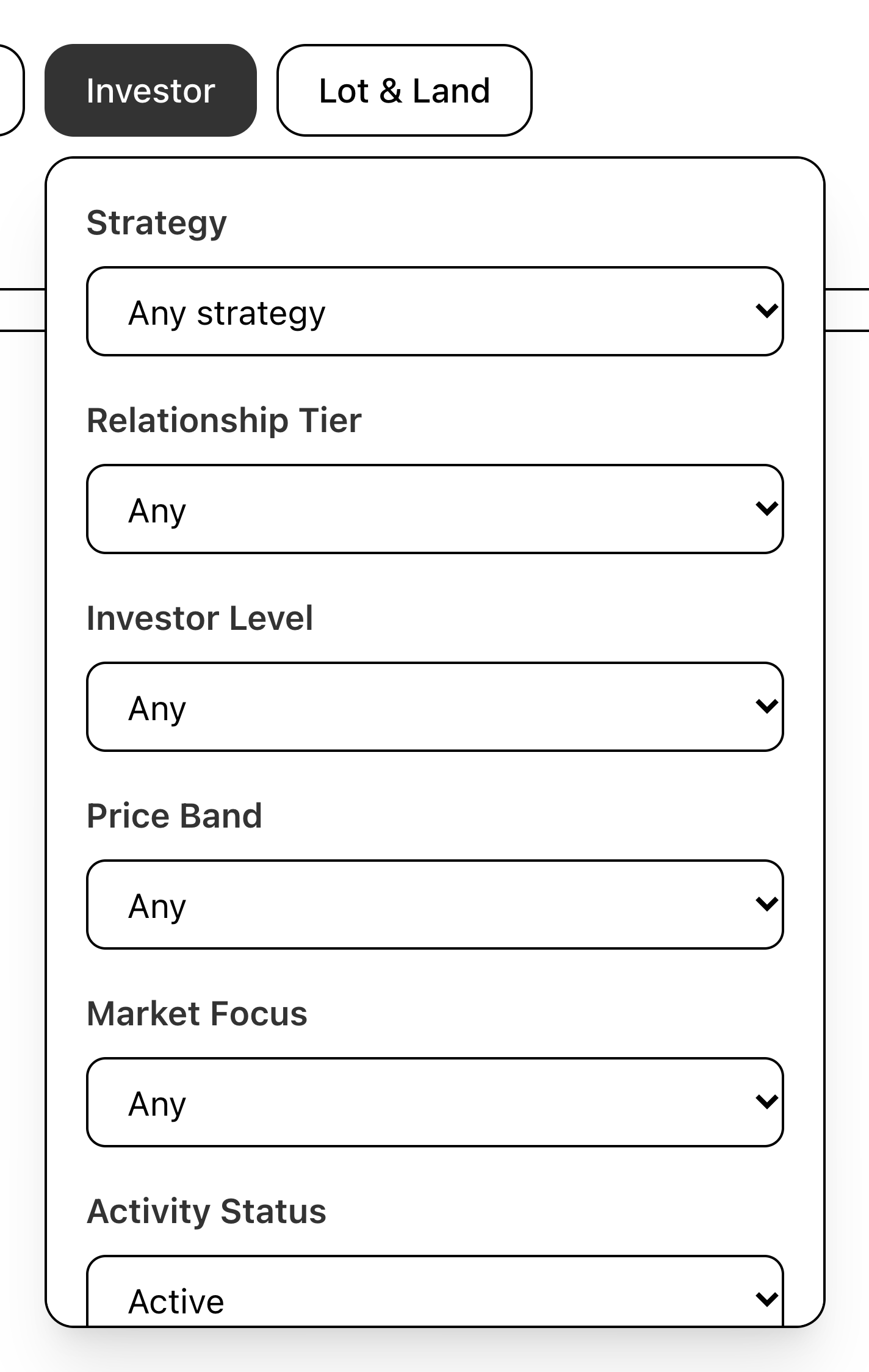 Activity Status separates investors still buying from those who have gone quiet.
Applied filters become chips you can remove one at a time.
Now your list is active investors with phone numbers. That is your calling pool for any contract in your market.
From there, you narrow further for the specific deal. If you have a contract in a particular ZIP or county, click the Locations pill and scope to that geography—you are looking for investors who have already decided that area is worth their capital.
- Click the Locations pill.
- Type a state, county or ZIP into Search state, county, or zip....
- Drill down state, then county, then ZIP. Click 100 ZIPs to expand a county and Hide to collapse it.
- Clicking a county filters to it straight away—no Apply needed.
 Search, then click the county to scope everything to it.
Now you can open any buyer's profile and scan their recent purchases to match the property type and price. If they fit, they go on your call list for this specific deal. If they do not, they stay in the active pool for the next contract that does match.
How to Use This on Your Next Call
Once you have the short list of warm buyers, the call changes. You are no longer introducing yourself to someone you hope might be interested. You are calling someone who has bought in your market, in your price range, in your property type, recently—and you are calling about a deal that matches what they actually buy.
The call becomes: "I have a [property type] at [address or neighborhood] in [location]. You bought [reference one of their recent deals in the same price range or type] last [timeframe]. I have this one at [price]. Does it pencil for you?"
That is a different conversation than "Do you buy in my market?" You are not asking if they buy. You are showing them you know they do, and you have something that matches. The callback rate and the close rate both move up.
The time you used to spend calling unqualified buyers—the dormant ones, the ones outside your price range, the ones who do not have phone numbers—is now time you spend calling warm leads and refining the deal. Fewer calls. More closes.


