
In Celina, Texas, the most common investor-owned property type is residential vacant land. In Columbus, Ohio, it is a condominium unit. In Charlotte, North Carolina, it is a townhouse.
None of those is a single-family house, and all three cities have busy cash-buying investors. If your mental model of a cash buyer is someone looking at a three-bedroom ranch, these markets will not behave the way you expect.
Land is a different business, not a cheap house
Celina, Anna, Denton, Little Elm, Frisco and Fort Worth all lead with residential vacant land in investor hands.
Someone buying a lot is not evaluating a property. They are evaluating a site. The questions are zoning, utilities at the street, access, lot dimensions, setbacks, and what can legally be built. Condition does not exist as a concept — there is nothing to inspect.
What that means for your pitch:
Repair language is noise. "Needs a roof" and "great bones" describe nothing a land buyer is purchasing.
Timelines run longer. A flipper wants to close and start demolition. A builder may be working around permitting, a construction loan draw schedule, and a crew calendar. Fast closing is worth less to them than certainty.
The comps are different. A lot's value comes from what the finished house will sell for minus build cost, not from what similar lots sold for in isolation.
Celina is the clearest case: about 91% of its investor activity is new construction, median year built 2025, and roughly 1% of investor-owned property predates 1980. That is a market where almost nothing being bought is an existing house.
Condos and townhouses carry their own underwriting
Columbus leads with condominium units — median size about 993 square feet across roughly 43,217 investor-owned properties. Charlotte leads with townhouses at about 1,664 square feet.
A condo investor is underwriting things a single-family investor never considers: HOA dues and whether they are rising, special assessments already voted or looming, rental caps that may prohibit leasing entirely, owner-occupancy ratios, and whether the building is even financeable.
That last point matters more than it sounds. Some buildings are effectively cash-only for reasons that have nothing to do with the individual unit. An investor who works that market knows which ones. One who does not will find out late and blame your deal.
So "cash buyer in Columbus" is not one audience. A buyer whose portfolio is condominiums and one whose portfolio is single-family houses are solving different problems with different financing and different exit assumptions.
Single-family is not the default you think
Worth pausing on how common the other types actually are.
Across the 164 publishable cities in our coverage, only 82 lead with single-family residential. Another 32 lead with residential vacant land. Seven lead with ranch, four with condominium, four with townhouse, three with a general vacant-land class, two with commercial vacant land, one with duplex. Twenty-eight report no top type at all.
So single-family leads in exactly half the cities we cover. The mental default that a cash buyer wants a house is right about half the time and quietly wrong the rest.
That is a high enough error rate to be worth one lookup before you pitch.
You can check this directly rather than inferring it from a listing. The Property Type filter carries every class the data recognises, so you can scope a market to land, condominium, townhouse or single-family before looking at a single property.
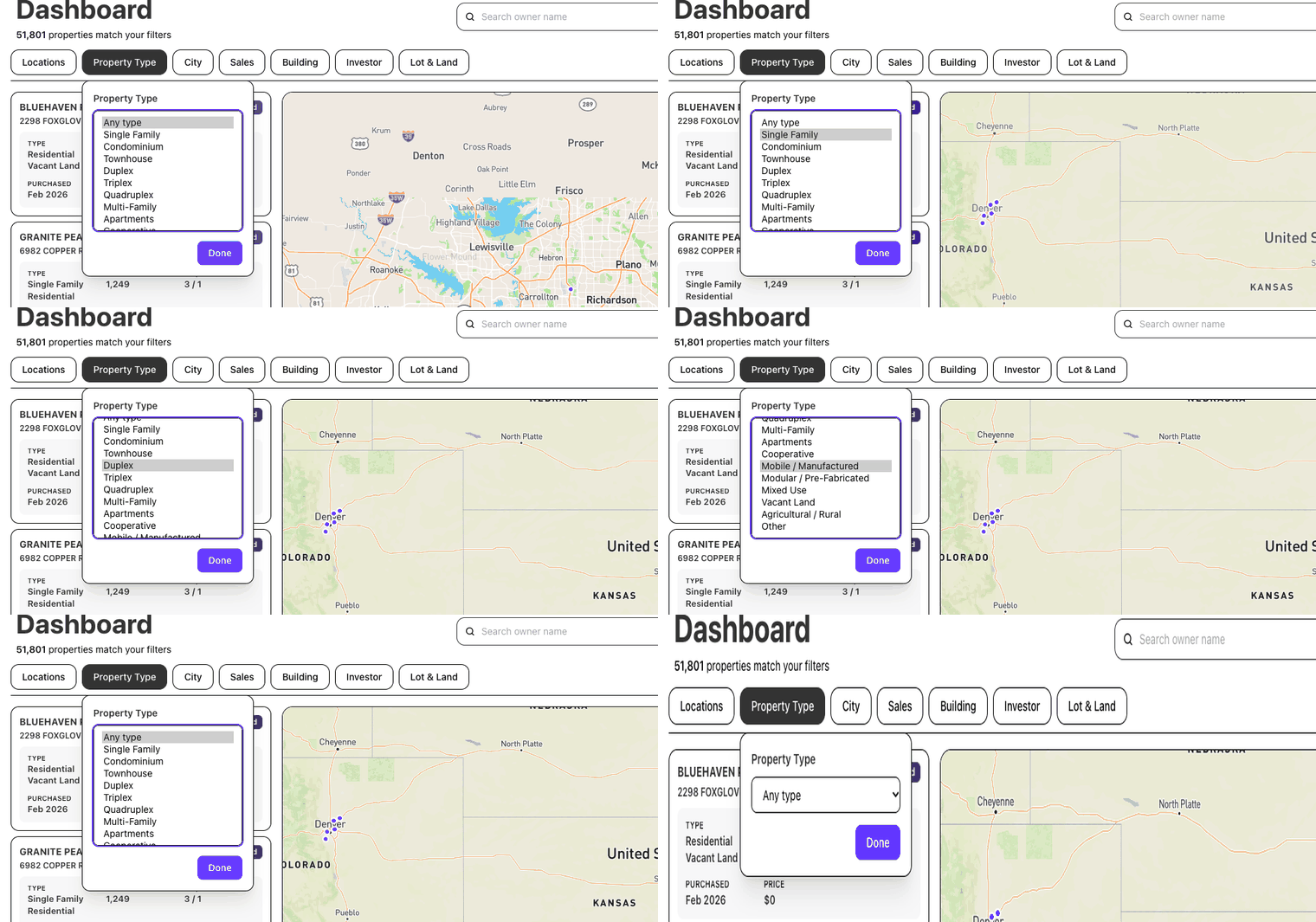 Every property class in one menu.
The single-family majority still varies
Most cities in our coverage do lead with single-family residential — McKinney, Princeton, Lavon, Farmersville, Plano, Allen, Wylie, Garland, Mesquite, Irving, Grand Prairie, Dallas, Denver, Aurora, Greensboro and Durham among them.
But the label covers wildly different properties.
McKinney's typical investor-owned property runs about 2,473 square feet with a median year built of 2024. Denver's runs about 1,106 square feet, median 1971. Garland's about 1,471, median 1976.
Both McKinney and Denver investors buy single-family houses with cash. One is buying new construction in a growing exurb; the other is buying small century-adjacent housing in an established city. Their crews, budgets, and exit strategies share almost nothing.
Reading the three fields together
Property type, size and year built form a quick profile that tells you what a market is actually doing.
Celina: vacant land, about 2,894 square feet of typical building where buildings exist, median year built 2025. A construction market where the product is mostly dirt.
Columbus: condominium, 993 square feet, median 1987, about 44% pre-1980. A small-unit rental market in older stock.
Garland: single-family, 1,471 square feet, median 1976, about 58% pre-1980. A classic rehab market.
Charlotte: townhouse, 1,664 square feet, median 2001. Attached housing of moderate age.
Four cities, four different businesses, none of which would be obvious from investor counts alone.
The limits
"Most common" is not "only." Celina leads with vacant land but has 567 active investors doing a range of things. The top type tells you the weighting, not the whole market. A good house deal in a land market still has buyers — there are simply fewer of them.
It is not reported everywhere. About 28 of our 164 publishable cities have no top property type recorded. Where it is blank, use size and year built instead rather than assuming single-family.
Type does not imply quality or price. A townhouse market is not inherently better or worse than a house market. It is a different product with different buyers.
The check before you build a list
Top property type tells you what you are selling into, and whether your deal is even the right product.
Median size tells you the scale of a typical job.
Median year built tells you whether condition is the opportunity or an irrelevance.
None of it requires a call or a conversation. It is three fields on a city row, and it settles a question that otherwise only surfaces after you have spent a week pitching the wrong people.
Run those three before you collect a single name. A buyer list built for the wrong product is not a thin list — it is the wrong list, and no amount of additional names fixes it. Adding another two hundred single-family buyers does nothing for a vacant lot.


