England, AR Cash Buyer Market
Investor purchase activity, drawn from the last 12 months of records.
Data last updated
In England, investors own about 9 tracked properties across 3 active buyers, with a median investor purchase price near $300,000. 5 were acquired in the last 12 months.
Acquisition Activity
Property Characteristics
Investment Strategy Mix
Hottest ZIP codes for investors
Inside the England numbers
Housing stock and strategy
The dominant play is buy & hold, at 100.0% of tracked activity. Buy-and-hold capital prices for yield rather than resale margin, so rent support matters more to these buyers than after-repair comps.
The rest of the mix is new construction (0.0%) and value-add / rehab (0.0%). Those secondary buyers are worth a line on your list — they tend to see less competition for the same contract.
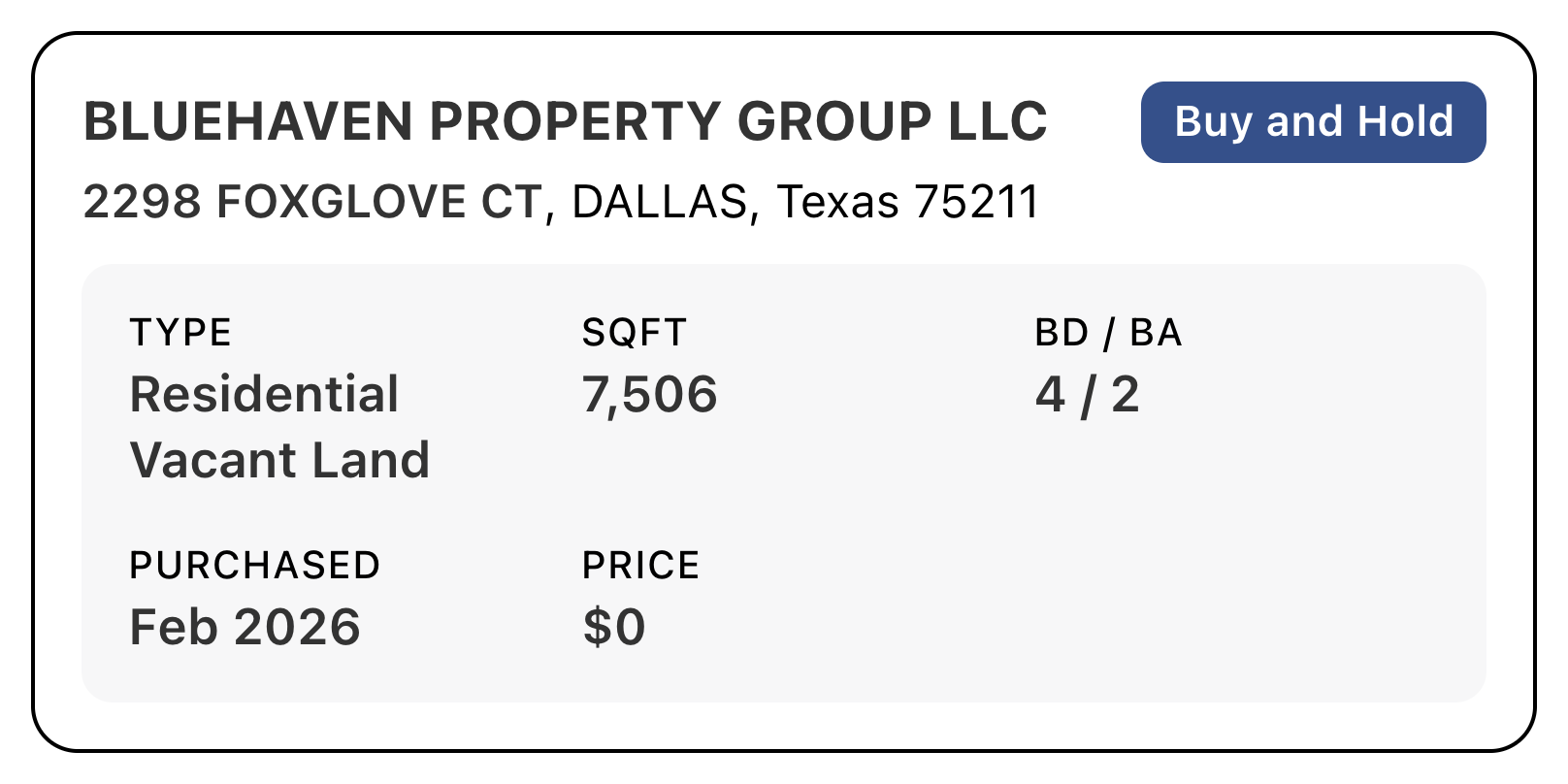
Residential Vacant Land is the property type investors buy most in England.
The England market at a glance
England has 3 active cash buyers holding roughly 9 properties. Averaging below 1.7 purchases per buyer last year, this is a wide, shallow pool — a numbers game where reach beats depth.
Investors here buy at a median of $300,000. With an average of $215,000, pricing is consistent across deals — few outliers in either direction.
Turnover is 55.6%: that is the share of investor-held properties acquired in the last 12 months. High turnover like this usually means flippers and short holds, so exit timing matters as much as entry price.
England versus its Pulaski County neighbors
Set against the other communities in Pulaski County, England comes in 11th out of 15 for investor buying (5 purchases in 12 months). A typical community in the county logs 20, so this is one of the quieter corners — less competition, smaller buyer pool. Put another way, under 1% of the county's investor deals in the last year happened here.
Investors pay more in England: a $300,000 median is about 369% above the $64,000 typical across Pulaski County. On price it sits between Cammack Village ($260,000) and Maumelle ($776,000).
Cammack Village behaves most like England on volume and price (5 purchases, $260,000 median), which makes it the natural second market to work. The county leader on volume is Little Rock (1,470 purchases), a useful benchmark for how deep demand can run here.
| Community | Active buyers | Purchases (12 mo) | Year over year | Median price | Median year built |
|---|---|---|---|---|---|
| Little Rock | 376 | 1,470 | +19% | $70,000 | 1963 |
| North Little Rock | 260 | 583 | +22% | $58,000 | 1957 |
| Jacksonville | 125 | 274 | +83% | $76,000 | 1963 |
| Maumelle | 58 | 145 | -10% | $776,000 | 2006 |
| Sherwood | 100 | 111 | -31% | $150,000 | 1978 |
| Wrightsville | 12 | 24 | +167% | $8,000 | 1974 |
| Roland | 23 | 20 | -23% | $210,000 | 1987 |
| England(this page) | 3 | 5 | — | $300,000 | — |
Reading England from every seat in the deal
It is worth thinking about what this looks like from the owner's porch. In a market trading at this rate, an owner in England is fielding repeated unsolicited interest — letters, texts, cold calls — and has likely stopped reading most of it. Arriving as one more identical approach is the fastest way to be ignored.
Deals near $300,000 are the natural range for bridge and hard-money lenders. That funding structure rewards certainty, so a clean file often beats a cheaper competing contract. Stock turning over at this rate implies a short hold: buy, improve, sell inside a year. Short holds concentrate risk in the resale market, so these buyers watch retail demand closely and will pull back quickly if it softens — their appetite can change faster than the underlying data suggests.
The typical England buyer is holding ground, not operating a property, so speed matters less here than basis. At $300,000, buyer intent matters more than price. The number alone does not tell you whether you are talking to renovation money or hold money, and those two want opposite things.
England clears the bar on the measure that matters. Roughly 56% of investor-held property traded inside a year — not a count that merely reflects size, but a rate that says capital here recycles quickly. With only 3 active buyers, relationship risk is real: lose one and you have lost a meaningful share of your exit options. Markets this thin reward depth over volume, and reward having a second area in rotation.
At roughly 1.7 deals per buyer, this is a balanced market. Buyers are active enough to be real and not so active that they can afford to be dismissive. Land-heavy markets see less wholesaler competition, because land requires a different conversation. That is a moat for anyone willing to learn the entitlement side.
Putting the England numbers to use
Buying concentrates in one place here: 72046 takes the largest share of investor purchases in England.
The honest risk in England is concentration. With 3 active buyers, a market this narrow can effectively close if two or three of them stop buying — and nothing in the data would warn you in advance, because the figures describe what already happened. Anyone building a pipeline here should keep a second market warm. Worth holding in mind that everything above is built from recorded sales, and recording lags closing. The picture is accurate and slightly behind — fine for choosing a market, less so for calling a turn.
If you are wholesaling in England, a contract priced between $255,000 and $345,000 sits inside the band where most investor money already moves. With buying this spread out, plan to put a deal in front of dozens of the 3 buyers rather than a handful.
3 contact records are on file for this area, which is the difference between a list of LLC names and people you can actually call.
A sensible entry into England starts with about 3 buyers — the ones whose purchase history matches your likely inventory — rather than with the full pool. Depth first, breadth later: you learn what this market pays by watching a handful of buyers closely. Third, move quickly when something appears. In a market trading at this rate, the gap between a contract becoming available and a buyer committing is short, and the wholesaler who already has photos, access and a clean summary ready wins deals that a slower competitor priced better.
Counts and prices here are drawn from recorded investor purchases in this city and refresh with new records. They are a record of past activity, not a forecast or investment advice.
Cash buyers by ZIP in England
Popular searches around England
Common questions
- How many investors are active in England?
- There are 3 active investors owning 9 tracked properties in England.
- What is the median investor purchase price in England?
- The median investor purchase price is about $300,000 in England.
- How active is the England investor market recently?
- 5 properties were acquired by investors in the last 12 months in England.
- Is there recent new-construction investor activity in England?
- 0 new-construction homes were acquired by investors in England in the last 90 days.