Who Is Buying in 76513 (Nolanville)
What cash buyers have been doing here in the last 12 months.
Data last updated
In Nolanville (76513), investors own about 48 tracked properties across 3 active buyers. 16 were acquired in the last 12 months.
Acquisition Activity
Property Characteristics
Investment Strategy Mix
Hottest ZIP codes for investors
What the 76513 numbers mean
The 76513 market at a glance
Acquisition pace is cooling: 16 properties bought in the last 12 months against roughly 30 the year before, down about 47%. Fewer buyers are competing per deal, which usually means more room to negotiate but a longer search for the right one.
Roughly 33.3% of what investors hold here changed hands in the past year. High turnover like this usually means flippers and short holds, so exit timing matters as much as entry price.
Investor ownership in 76513 runs to roughly 48 properties, spread across 3 active buyers. At roughly 5.3 purchases each over the past year, this is a concentrated pool: a handful of operators are doing the bulk of the buying, so relationships matter more than list size.
Housing stock and strategy
The dominant play is new construction, at 100.0% of tracked activity. Buyers are absorbing newly built inventory, so wholesalers working tired or distressed stock are pitching against the grain of what this market's capital is actually doing.
It is not a one-strategy market — value-add / rehab (0.0%) and buy & hold (0.0%) also show up in the records, which widens the set of deals that can close.
The stock investors chase here is mostly residential vacant land. The typical investor-held building is about 2,314 square feet, roomy by most buyers' standards.
Investor-held stock here dates to a median of 2025. Just 0.0% was built before 1980, which keeps renovation scopes and disclosure burdens down.
No new-construction purchases by investors were recorded in the last 90 days, so this is a resale market. At 100.0% new construction versus 0.0% value-add, buyers here lean toward fresh inventory.
76513 versus its Bell County neighbors
Set against the other ZIP codes in Bell County, ZIP 76513 comes in 12th out of 18 for investor buying (16 purchases in 12 months). A typical ZIP code in the county logs 53, so this is one of the quieter corners — less competition, smaller buyer pool. It accounts for under 1% of all investor purchases recorded in Bell County.
Momentum matches the county: purchases in ZIP 76513 are down 47% year over year, in step with Bell County as a whole (down 51%).
The homes are newer than the county norm: median 2025 against 1995 in the typical ZIP code, 30 years younger. Only 0% of the stock predates 1980, well under the 25% typical nearby, which keeps renovation surprises down. Buildings are larger too, around 2,314 sq ft versus 1,645 for the county's typical ZIP code.
76502 in Temple tops Bell County with 334 purchases — many of the county's most active buyers will be working there too.
| ZIP code | Active buyers | Purchases (12 mo) | Year over year | Median year built |
|---|---|---|---|---|
| 76502 (Temple) | 100 | 334 | -74% | 1999 |
| 76542 (Killeen) | 81 | 294 | -5% | 1997 |
| 76549 (Killeen) | 71 | 177 | +97% | 2000 |
| 76504 (Temple) | 88 | 168 | -52% | 1973 |
| 76559 (Nolanville) | 28 | 97 | +411% | 2006 |
| 76571 (Salado) | 50 | 89 | -78% | 2025 |
| 76548 (Harker Heights) | 62 | 80 | +74% | 1993 |
| 76513 (Nolanville)(this page) | 3 | 16 | -47% | 2025 |
Reading 76513 from every seat in the deal
76513 reads as a market under construction. New building carries real weight in the investor record and the housing is young — the profile of an area where supply is still being added rather than traded. What that means in practice is a tougher bar for tired stock. When clean new product is available, the discount required to move a dated house widens.
At about 5.3 purchases per buyer, these are operators rather than occasional investors. High-volume buyers are selective precisely because they have alternatives, so a deal has to be good relative to their current pipeline, not merely good in the abstract. Land-heavy markets see less wholesaler competition, because land requires a different conversation. That is a moat for anyone willing to learn the entitlement side.
It is worth thinking about what this looks like from the owner's porch. In a market trading at this rate, an owner in 76513 is fielding repeated unsolicited interest — letters, texts, cold calls — and has likely stopped reading most of it. Arriving as one more identical approach is the fastest way to be ignored. In housing this new, condition rarely drives the decision. Expect circumstance-led sellers, and an offer framed around a clean, fast close rather than around rescuing a problem property.
Stock turning over at this rate implies a short hold: buy, improve, sell inside a year. Short holds concentrate risk in the resale market, so these buyers watch retail demand closely and will pull back quickly if it softens — their appetite can change faster than the underlying data suggests.
About 1 investor purchases a month is the throughput here. A wholesaler planning volume should size their effort against that number rather than against the total buyer count, which overstates how much any month can hold.
The buyer in 76513 is acquiring dirt for a project; their math starts with what can be approved, not what currently stands. There is not enough recorded price data in 76513 to quote a trustworthy median, so pricing conversations here lean on individual buyers' records rather than on an area figure.
For a wholesaler weighing whether to farm 76513, turnover is the number that decides it: about 33% of investor-held property here changed hands in twelve months, which is top-quartile movement. Stock that trades is stock with buyers waiting behind it. A pool of 3 is thin enough that each buyer matters. Treat the relationships as infrastructure, and do not build a pipeline that depends on any single one of them saying yes.
Putting the 76513 numbers to use
A pool of 3 is thin, and thin pools fail suddenly rather than gradually. Treat 76513 as one market in a set, not as a pipeline on its own. Worth holding in mind that everything above is built from recorded sales, and recording lags closing. The picture is accurate and slightly behind — fine for choosing a market, less so for calling a turn.
Agreedment holds 4 buyer contact records for 76513, about 1.3 per active buyer, so most names on the list come with a way to reach them.
If 76513 is new to you, the first move is narrowing rather than broadening: build a shortlist of roughly 3 buyers whose recorded purchases match the kind of property you can actually source, and learn those names properly before widening. A small list worked well outperforms a long one worked thinly, and the data to build it already exists in the purchase record. Second, pick your ground. Activity in 76513 concentrates rather than spreading evenly — 76559 and 76513 carry a disproportionate share — so farming the whole area equally wastes effort on blocks where investors are barely transacting. Rank by turnover rather than raw count, because raw count mostly measures how big a ZIP is. Third, move quickly when something appears. In a market trading at this rate, the gap between a contract becoming available and a buyer committing is short, and the wholesaler who already has photos, access and a clean summary ready wins deals that a slower competitor priced better.
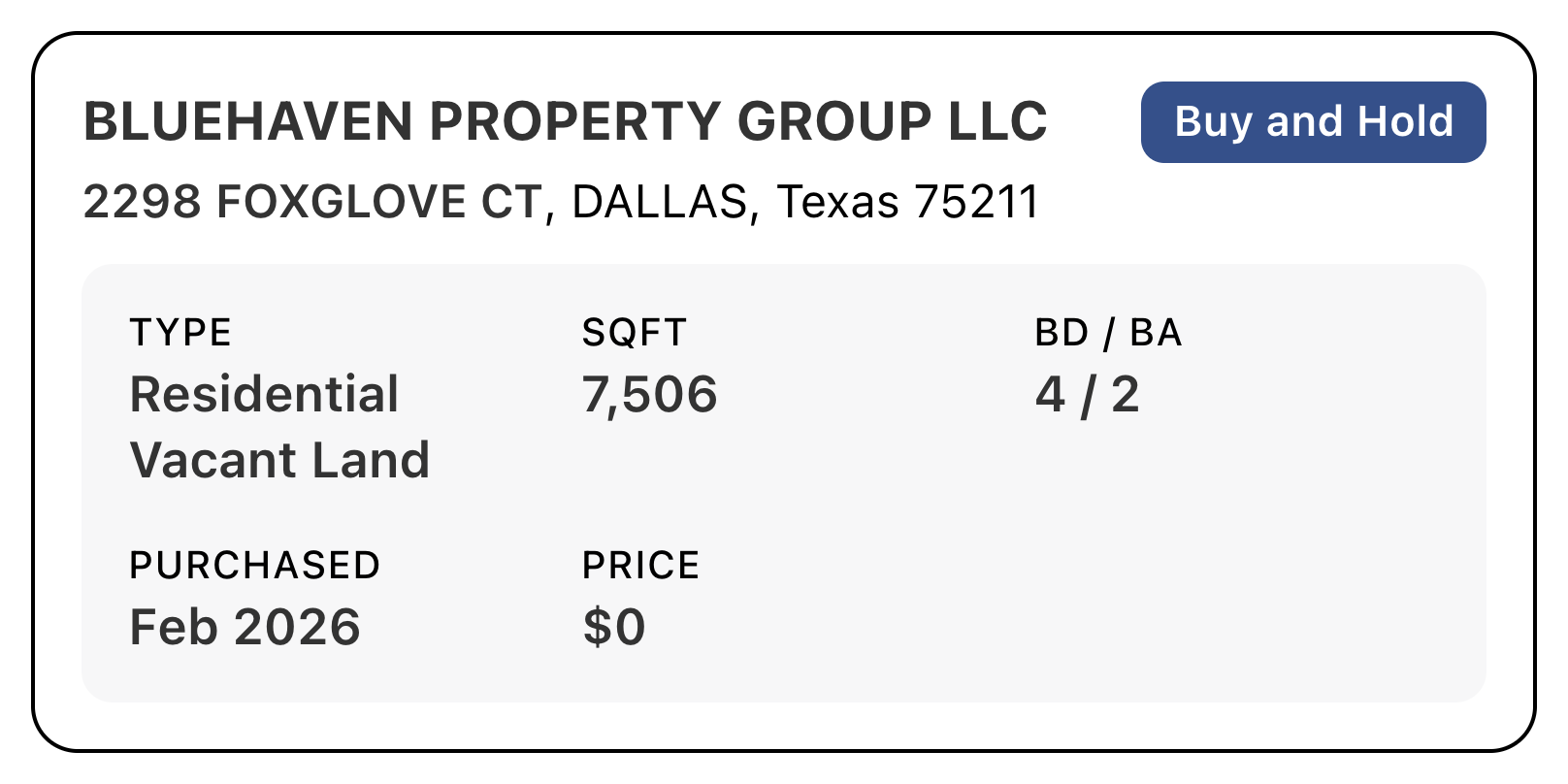
Counts and prices here are drawn from recorded investor purchases in this ZIP code and refresh with new records. They are a record of past activity, not a forecast or investment advice.
Common questions
- How many investors are active in Nolanville?
- There are 3 active investors owning 48 tracked properties in Nolanville.
- How active is the Nolanville investor market recently?
- 16 properties were acquired by investors in the last 12 months in Nolanville.
- Is there recent new-construction investor activity in Nolanville?
- 0 new-construction homes were acquired by investors in Nolanville in the last 90 days.