Who Is Buying in Goodyear, AZ
Cash-buyer and investment activity over the last 12 months.
Data last updated
In Goodyear, investors own about 5,101 tracked properties across 209 active buyers, with a median investor purchase price near $12,883,000. 1,338 were acquired in the last 12 months.
Acquisition Activity
Property Characteristics
Investment Strategy Mix
Hottest ZIP codes for investors
What investors are doing in Goodyear
Volume, pace and price in Goodyear
Investors here buy at a median of $12,883,000. The average of $24,752,000 sits well above it, so a tail of higher-priced deals is pulling the mean up — most activity happens below the average, and pricing off the median is the safer read.
Across Goodyear, 209 active buyers account for approximately 5,101 investor-held properties. At roughly 6.4 purchases each over the past year, this is a concentrated pool: a handful of operators are doing the bulk of the buying, so relationships matter more than list size.
Acquisition pace is cooling: 1,338 properties bought in the last 12 months against roughly 1,731 the year before, down about 23%. Fewer buyers are competing per deal, which usually means more room to negotiate but a longer search for the right one.
Roughly 26.2% of what investors hold here changed hands in the past year. That is a fast-cycling market: positions here are short, and a buyer who passed last quarter may be back this one.
How to approach Goodyear as a wholesaler
Activity is not spread evenly. ZIPs 85338 and 85395 are absorbing the most investor purchases in Goodyear, and they are the fastest place to start a buyer list before working outward through the rest of the city.
209 buyers sounds like safety and often behaves like distraction. Large pools hide the fact that most members are inactive in any given quarter, so filtering by recent purchases matters more here than anywhere. Price dispersion is wide enough to mislead. Because the mean sits far above the median, an average-based comp will overstate what this market pays, and a contract priced that way sits unsold while the wholesaler blames the buyers. One structural caveat applies to all of it: these figures come from recorded transactions, which lag the market by weeks to months depending on how quickly the county records. A market that turned last month looks unchanged here, so treat the numbers as a reliable description of the recent past rather than a live feed.
If you are wholesaling in Goodyear, a contract priced between $10,951,000 and $14,815,000 sits inside the band where most investor money already moves. A shortlist of about 21 high-volume buyers is where to send a deal first. In a cooling market, price the assignment conservatively — buyers have options and they know it.
A sensible entry into Goodyear starts with about 25 buyers — the ones whose purchase history matches your likely inventory — rather than with the full pool. Depth first, breadth later: you learn what this market pays by watching a handful of buyers closely. Then narrow geographically. 85338 and 85395 account for an outsized share of the buying here, and effort spent outside them competes for the same hours at a lower hit rate. The right ranking is purchases divided by investor-held stock, not purchases alone. Finally, budget time. Slow turnover means a longer search for the buyer who is actually active this quarter, and an assignment priced for a quick flip will erode while you look.
What trades in Goodyear, and why
Investor-held stock here dates to a median of 2009. Only about 0.8% predates 1980, so the stock skews newer and rehab scopes tend to be lighter.
New construction is part of the flow here: 13 purchases over 90 days, a run rate near 4.3 per month (7 in the latest 30 days). 11 tracked investments involve construction — a signal of buyers willing to build or rebuild. New construction (35.8%) outweighs value-add (0.8%), so turnkey product competes with what builders are delivering.
Strategy here skews to buy & hold, which accounts for 63.4% of tracked deals. Because these buyers underwrite to cash flow, a credible rent figure moves a deal further than a renovation estimate.
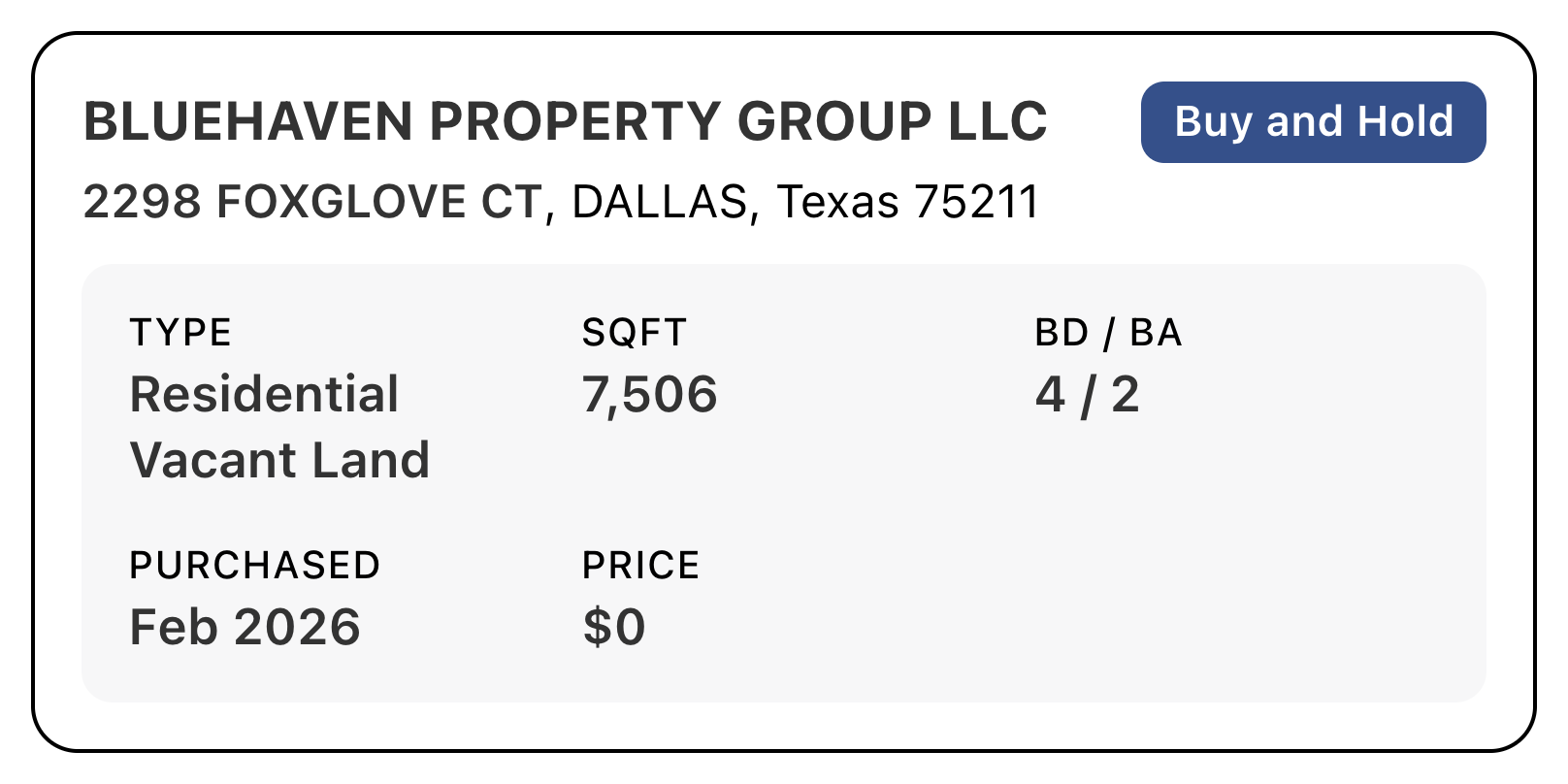
The stock investors chase here is mostly residential vacant land. The typical investor-held building is about 1,862 square feet, roomy by most buyers' standards. Dividing the median price by the median size gives a rough $6919 per square foot — a quick sanity check before you trust a comp.
Where Goodyear ranks in Maricopa County
Goodyear sits 4th among 37 Maricopa County communities by 12-month investor purchases — 1,338 of them. That is about 11.8× the 114 logged by a typical community in the county. It accounts for 5.3% of all investor purchases recorded in Maricopa County.
If you like Goodyear, look at Peoria next — similar volume (1,193 deals) and similar pricing ($8,195,000). For scale, the county's busiest community is Phoenix, at 4,347 investor purchases.
Investors pay more in Goodyear: a $12,883,000 median is about 2375% above the $520,500 typical across Maricopa County. Its nearest neighbors on the price ladder are Waddell just below at $10,205,000 and Tempe just above at $47,500,000.
Momentum runs against Goodyear: purchases are down 23% year over year, 43 points behind the county (up 20%).
Goodyear skews newer, with a 2009 median build year — 10 years later than most of Maricopa County. Only 1% of the stock predates 1980, well under the 11% typical nearby, which keeps renovation surprises down.
| Community | Active buyers | Purchases (12 mo) | Year over year | Median price | Median year built |
|---|---|---|---|---|---|
| Phoenix | 1,215 | 4,347 | +3% | $1,200,000 | 1986 |
| Buckeye | 291 | 3,218 | +74% | $5,253,000 | 2019 |
| Mesa | 490 | 1,381 | +10% | $500,000 | 1998 |
| Goodyear(this page) | 209 | 1,338 | -23% | $12,883,000 | 2009 |
| Surprise | 298 | 1,299 | -31% | $1,851,000 | 2006 |
| Glendale | 463 | 1,249 | +95% | $1,017,000 | 1987 |
| Peoria | 327 | 1,193 | -17% | $8,195,000 | 1998 |
| Avondale | 187 | 1,074 | -14% | $8,029,000 | 2004 |
Who is buying in Goodyear, and what they are solving for
Goodyear reads as a market under construction. New building carries real weight in the investor record and the housing is young — the profile of an area where supply is still being added rather than traded. What that means in practice is a tougher bar for tired stock. When clean new product is available, the discount required to move a dated house widens. The 11 construction-linked investments on record are the concrete version of that: capital already committed to building here, which is a harder signal to fake than sentiment.
Goodyear turns over about 26% annually, around the middle of the range. Results here will track the quality of your buyer list more than the heat of the market. With 209 active buyers, the constraint here is not finding someone to call but choosing correctly: a pool this size rewards filtering by what each buyer has actually purchased before you dial, rather than working the list top to bottom.
Owners in Goodyear see periodic investor interest. That is a useful middle: the concept is familiar, the fatigue has not set in. Old stock creates its own sellers. In housing this age, deferred maintenance eventually forces a decision, and selling as-is to cash is frequently the cheaper path for an owner who cannot or will not take on the work.
Purchases around $12,883,000 usually sit above what an individual funds alone, so the buyer across the table is often deploying someone else's capital. That adds an approval layer, and it is why a buyer who sounds enthusiastic can still take two weeks to commit. With turnover neither fast nor stalled, both resale and hold strategies are viable here. Ask which one a given buyer runs before pricing the assignment, since their timelines are not the same.
About 112 investor purchases a month is the throughput here. A wholesaler planning volume should size their effort against that number rather than against the total buyer count, which overstates how much any month can hold. New-construction activity is running hot right now: 13 of the 11 construction-linked investments on record landed in the last 90 days. A concentration that recent usually means something changed locally — an approval, a road, an employer — and whatever it was, builders noticed before the broader market did.
The buyer in Goodyear is acquiring dirt for a project; their math starts with what can be approved, not what currently stands. Because that $12,883,000 median is a project basis, the pitch that works is about what the site allows, not about what the existing structure is worth.
Figures describe recorded investor purchases in this city and are refreshed as new records are processed. They describe past activity and are not a forecast or investment advice.
Cash buyers by ZIP in Goodyear
Popular searches around Goodyear
What people ask about this market
- How many investors are active in Goodyear?
- There are 209 active investors owning 5,101 tracked properties in Goodyear.
- What is the median investor purchase price in Goodyear?
- The median investor purchase price is about $12,883,000 in Goodyear.
- How active is the Goodyear investor market recently?
- 1,338 properties were acquired by investors in the last 12 months in Goodyear.
- Is there recent new-construction investor activity in Goodyear?
- 13 new-construction homes were acquired by investors in Goodyear in the last 90 days.