Who Is Buying in Crossroads, TX
Cash-buyer and investment activity over the last 12 months.
Data last updated
In Crossroads, investors own about 22 tracked properties across 13 active buyers. 3 were acquired in the last 12 months.
Acquisition Activity
Property Characteristics
Investment Strategy Mix
Hottest ZIP codes for investors
What investors are doing in Crossroads
The Crossroads market at a glance
Acquisition pace is cooling: 3 properties bought in the last 12 months against roughly 9 the year before, down about 67%. Fewer buyers are competing per deal, which usually means more room to negotiate but a longer search for the right one.
13.6% of the investor-owned stock in Crossroads was bought within the last 12 months. That implies an average hold somewhere near 7 years — steady churn rather than a revolving door.
Investor ownership in Crossroads runs to roughly 22 properties, spread across 13 active buyers. Fewer than 0.2 purchases per buyer over the past year means buying is thinly spread, so breadth of outreach matters more than any one contact.
Housing stock and strategy
The dominant play is buy & hold, at 100.0% of tracked activity. Buy-and-hold capital prices for yield rather than resale margin, so rent support matters more to these buyers than after-repair comps.
The rest of the mix is new construction (0.0%) and value-add / rehab (0.0%). Those secondary buyers are worth a line on your list — they tend to see less competition for the same contract.
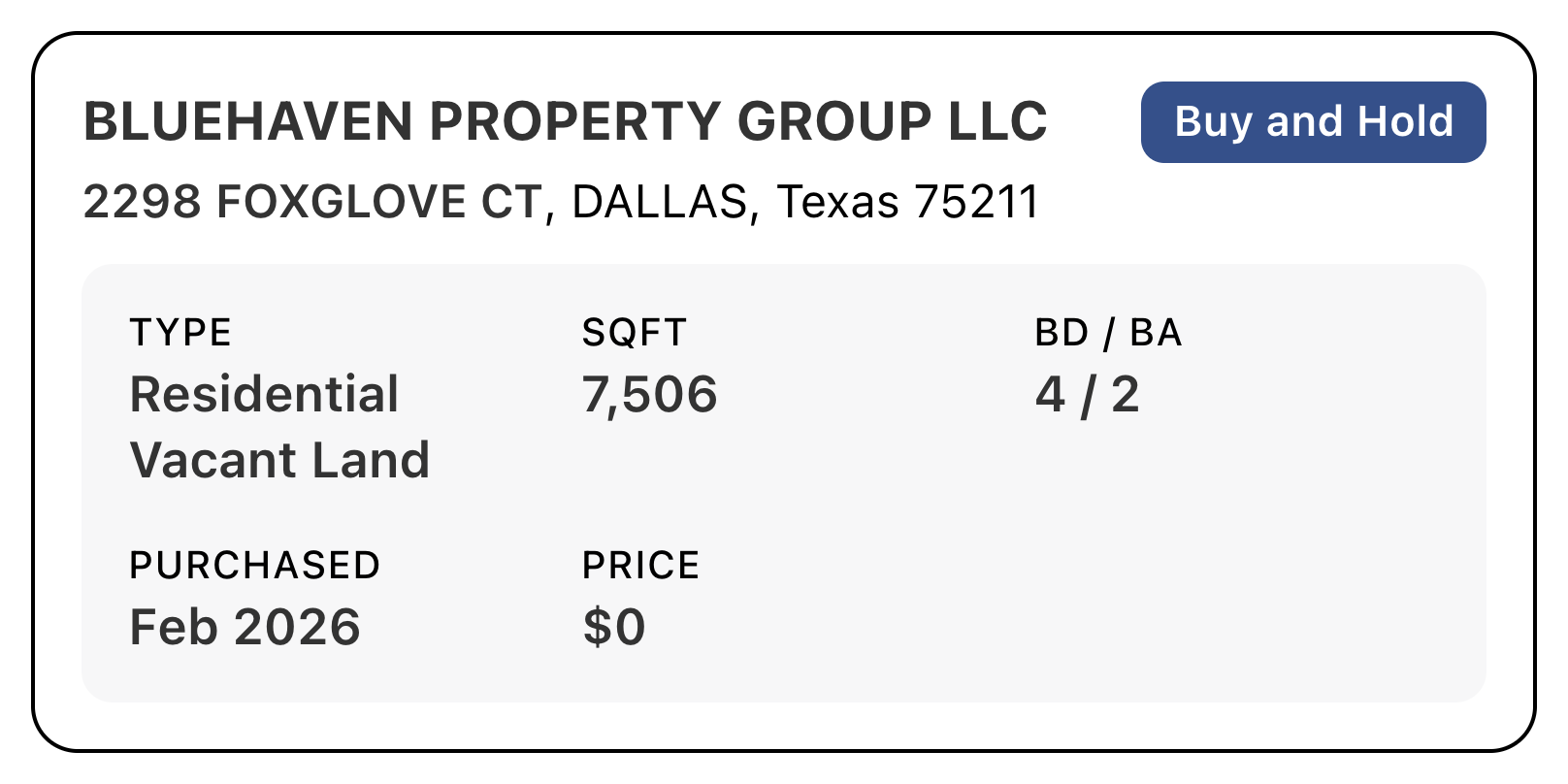
Vacant Land is the property type investors buy most in Crossroads. The typical investor-held building is about 2,018 square feet, roomy by most buyers' standards.
Investor-held stock here dates to a median of 2018. At 0.0% pre-1980, this is comparatively new housing — lighter rehab, fewer legacy-systems surprises.
Investors have not bought new builds here in the past three months; the action is in existing homes. New construction (0.0%) and value-add (0.0%) are close to balanced, so both clean and rough product can find a buyer.
Crossroads versus its Denton County neighbors
Within Denton County, Crossroads ranks 36th of 37 communities on investor purchases, with 3 over the last year. Against a county-typical 115, that is a lighter market, which can mean less bidding pressure on each contract. It accounts for under 1% of all investor purchases recorded in Denton County.
The homes are newer than the county norm: median 2018 against 2011 in the typical community, 8 years younger.
For scale, the county's busiest community is Denton, at 1,235 investor purchases.
Crossroads is lagging the county. Purchases here are down 67% on the year while Denton County is up 9%, so buyers are finding deals elsewhere.
| Community | Active buyers | Purchases (12 mo) | Year over year | Median year built |
|---|---|---|---|---|
| Denton | 212 | 1,235 | -13% | 2002 |
| Justin | 101 | 644 | +10% | 2007 |
| Pilot Point | 74 | 615 | +117% | 2022 |
| Fort Worth | 45 | 599 | +274% | 2025 |
| Aubrey | 124 | 561 | -8% | 2017 |
| Providence Village | 45 | 414 | +144% | 2024 |
| Northlake | 40 | 338 | +117% | 2024 |
| Crossroads(this page) | 13 | 3 | -67% | 2018 |
Reading Crossroads from every seat in the deal
The signature here is expansion. A meaningful share of investor activity is new construction and the stock skews recent, which is what a growing footprint looks like in the data. Builders commit before the growth is visible, so this pattern tends to lead rather than follow. The practical effect is on condition. In a market where buyers can choose new, a property needing work competes on price alone, and the gap is wider than a comp sheet implies.
At roughly 14% of investor stock trading per year, Crossroads is a middling market on movement: workable, without the tailwind a hotter area gives you. With only 13 active buyers, relationship risk is real: lose one and you have lost a meaningful share of your exit options. Markets this thin reward depth over volume, and reward having a second area in rotation.
There is a crowding problem worth naming: 13 active buyers against 3 purchases over twelve months means fewer than one completed deal per buyer per year. Most of these buyers did not transact recently, so a contract here meets competition on the buy side — and an assignment fee priced as though buyers are desperate will not survive contact. The land concentration is an opening. Most wholesalers are built for houses and skip dirt entirely, so the competition for land contracts here is thinner than the buyer count suggests — provided you can speak to zoning and utilities credibly.
The owner's view in Crossroads sits in between: enough investor interest that an unsolicited offer is not startling, not enough that it is background noise. A specific, well-supported approach tends to get a real hearing here. Because the housing here is newer, the usual repair-driven motivation is mostly absent. An owner selling in Crossroads is more often responding to a life event — relocation, a job change, a separation, an inherited property they do not want — than to a building problem, and a pitch built around distress will miss.
With turnover neither fast nor stalled, both resale and hold strategies are viable here. Ask which one a given buyer runs before pricing the assignment, since their timelines are not the same.
The typical Crossroads buyer is holding ground, not operating a property, so speed matters less here than basis. Recorded prices are too sparse here to publish a reliable median, which is itself worth knowing: in a thin-data market, a buyer's own purchase history is the only dependable guide to what they will pay.
Putting the Crossroads numbers to use
Crossroads carries real single-point risk: 13 buyers is few enough that the loss of one or two materially changes your options. Historical figures cannot flag that in advance, so diversification across markets is the only practical hedge. These numbers describe completed, recorded transactions. That makes them solid ground for strategy and a poor instrument for timing, since the most recent weeks are always underrepresented.
Activity is not spread evenly. ZIP 76227 absorbs the most investor purchases in Crossroads, and it is the fastest place to start a buyer list.
For outreach, there are 15 contact records tied to buyers in Crossroads inside the platform — more than one per active buyer.
A sensible entry into Crossroads starts with about 3 buyers — the ones whose purchase history matches your likely inventory — rather than with the full pool. Depth first, breadth later: you learn what this market pays by watching a handful of buyers closely. Finally, budget time. Slow turnover means a longer search for the buyer who is actually active this quarter, and an assignment priced for a quick flip will erode while you look.
Counts and prices here are drawn from recorded investor purchases in this city and refresh with new records. They are a record of past activity, not a forecast or investment advice.
Cash buyers by ZIP in Crossroads
Popular searches around Crossroads
Answers to the usual questions
- How many investors are active in Crossroads?
- There are 13 active investors owning 22 tracked properties in Crossroads.
- How active is the Crossroads investor market recently?
- 3 properties were acquired by investors in the last 12 months in Crossroads.
- Is there recent new-construction investor activity in Crossroads?
- 0 new-construction homes were acquired by investors in Crossroads in the last 90 days.