A wholesaler works two markets at once
"Buyer's market" and "seller's market" are retail terms. They describe homeowners and the people buying from them. A wholesaler stands between two different groups: the motivated seller you put under contract, and the cash buyer you assign to. Each side can be tight or loose on its own schedule, and the headline about your metro usually describes neither.
The real question is not whether your market is "hot" overall. It is whether investors in your county are buying right now, and whether they want the kind of deal you are holding. Those two things move independently, and they change what you can charge and how long you have to move. (If you are still deciding which side of the business to build first, start with buyer-first vs. seller-first wholesaling. This post is about how the market around you changes what each side will accept.)
What changes when investor buying stays strong
When cash buyers are closing deals at a steady pace, dispo becomes a strength. Investors are actively underwriting, capital is deployed, and a clean contract in the right price range will find a home. That speed lets you take more risk on acquisition: if you know buyers are hungry, you can be confident a contract at a reasonable spread will move.
But steady buying also invites the mistake that kills thin margins. Easy dispo tempts you to overpay on the contract, betting that "someone will take it." They might—but not at a price that covers your time and risk. The better play is to keep the contract price disciplined, knowing you have dispo strength to lean on if the first buyer passes.
Your advantage is certainty and speed of close. When sellers have options, the wholesaler who can show a buyer already lined up and a clean timeline wins the contract. Lead with that.
What changes when investor buying cools
When investor acquisitions drop sharply, dispo becomes the bottleneck. Fewer buyers are underwriting, capital is tighter, and a contract you cannot move becomes a liability. A property on your books is carrying costs and opportunity cost every day it sits.
That shift forces three changes. First, your contract price has to be set by what buyers in that county actually pay right now, not by last year's comps or the seller's asking price. If investors have pulled back, the spread between your contract and what a buyer will pay has widened—the only way to close that gap is at the contract, not later.
Second, you need more margin to absorb a longer marketing cycle. The longer a contract takes to assign, the more your holding costs and the risk that a buyer changes their mind both go up. That gap is the wholesaler's to carry, not the buyer's.
Third, your list of workable buyers shrinks. In a strong market, most of the investors on your list are buying. In a cooling market, some have gone quiet and the rest are being choosy. You need to know which buyers are still transacting and what they actually want, not just have a generic list.
The honest test: investor pace over time
The useful measure is how fast investors are buying right now compared with before. Compare a county's last 12 months of investor acquisitions with its two-year total. If the latest year carries roughly half the two-year total, the pace is holding. If it carries noticeably less than half, buying is slowing; at a third or less, it has cooled sharply. That gap tells you whether you are in a dispo-friendly market or a dispo-constrained one.
Consider what the numbers show across a few markets. Dallas County, Texas logged 5,952 investor acquisitions in the last 12 months out of 11,908 over 24 months—pace holding, with 2,661 active investors still transacting. Collin County, Texas recorded 23,292 in the last 12 months out of 44,529 over 24—also holding pace, and the busiest county tracked, with 3,378 active investors.
Contrast that with Franklin County, Ohio, where Columbus sits. Investors there made 9,516 acquisitions in the last 12 months, but 30,983 over the full 24-month window. Less than a third of two years' buying happened in the latest year, signaling a sharp cooldown. The county still has 688 active investors and a median investor purchase price of $137,000, but the volume drop is real. Denver County, Colorado saw 678 acquisitions in the last 12 months against 1,504 over 24 months—slowed, with 242 active investors and a median purchase price of $740,000. Guilford County, North Carolina recorded 453 in the last 12 months against 1,029 over 24—also slowed, with 107 active investors and a median of $175,000.
Figures: Townhall investor activity data for Dallas County, Collin County, Franklin County, Denver County and Guilford County.
The same headline month can describe a seller's market for dispo in Dallas County and a buyer's market for dispo in Columbus. The metro news does not tell you that difference. The county data does.
Pace is half; appetite is the other half
A strong acquisition pace does not mean every property will move. Investors in hot counties often concentrate on one strategy, and a contract outside that lane can sit idle even while the county burns.
Collin County, for example, runs at a strong pace but 62.6% of investor activity is new construction. Most of the buying there is building. A distressed rehab contract, even one at a good price, can linger because it is not what those investors are built to handle. Franklin County tells a different story: 46.7% of investor activity is value-add and rehab. Denver County runs 53.4% value-add. Guilford County, 42.5% value-add. In those markets, even though overall pace has cooled, the investors still active lean toward a house that needs work.
The implication is straightforward. Do not check only how much investors are buying; check what they are buying. A county with solid pace but zero appetite for your property type is a buyer's market for dispo, regardless of the headline.
When investor pace is holding: move with speed
If a county's latest 12 months of buying track close to half its 24-month total, dispo strength is a given. Investors are still underwriting actively, capital is committed, and a clean contract at a reasonable price will find a buyer.
In this environment, your playbook shifts toward the acquisition side. Have buyers lined up or at least warm before you sign a contract—you can afford to be fast because dispo will not be the bottleneck. Do not let easy dispo seduce you into overpaying at acquisition. Knowing you can move a contract does not mean you should pay too much for it; it means you can be confident and disciplined about price. Lead with certainty of close: a buyer already lined up and a timeline the seller can count on. Speed and certainty are what differentiate you in a competitive dispo environment, not a discount.
When investor pace has cooled: match contract to buyer appetite
If a county's latest 12 months of buying falls well under half of its two-year total, you are in a buyer's market for dispo, and at a third or less, a hard one. Investors are picking deals harder, capital is tighter, and dispo is the risk.
Set your contract price from what buyers in that county actually pay, not from comps or seller expectation. If investors are more cautious, the only way to close is to be realistic about what they will underwrite. Widen your spread to account for a longer marketing window, slower underwriting, and the possibility that you move the deal to a second or third buyer before it closes. Your buyer list shrinks, so find the investors still active in that county and watch for any who are re-entering after a pause. Match the property to the strategy the remaining buyers actually run—if it is a value-add deal in a value-add market, great; if it is in a construction-heavy market, you have a problem that no amount of marketing will solve.
Finding the buyers still buying
The difference between a dispo-friendly market and a dispo-constrained one comes down to one question: which investors are actually underwriting and closing deals right now? When pace cools, that list shrinks. When pace holds, you want to know about new buyers entering. Either way, you need to filter your buyer list to the ones actively transacting.
To surface investors who are buying today, start by filtering to Active status. This separates investors who have closed deals recently and are still underwriting from those who have gone quiet or slowed down.
- Open the Dashboard. The count under the title reflects your entire coverage area unless you have already set filters.
- Click the Investor pill in the filter bar. This panel describes the property owner, not the building itself.
- Under Activity Status, choose Active—these are investors who have bought recently and are still transacting right now.
- Scroll to Data Available and click Has Phone, so your list is only investors you can actually reach.
- Click Apply. Your filters appear as removable chips under the toolbar and the property count updates to match both filters.
 The whole flow: Investor, Activity Status, Has Phone, Apply.
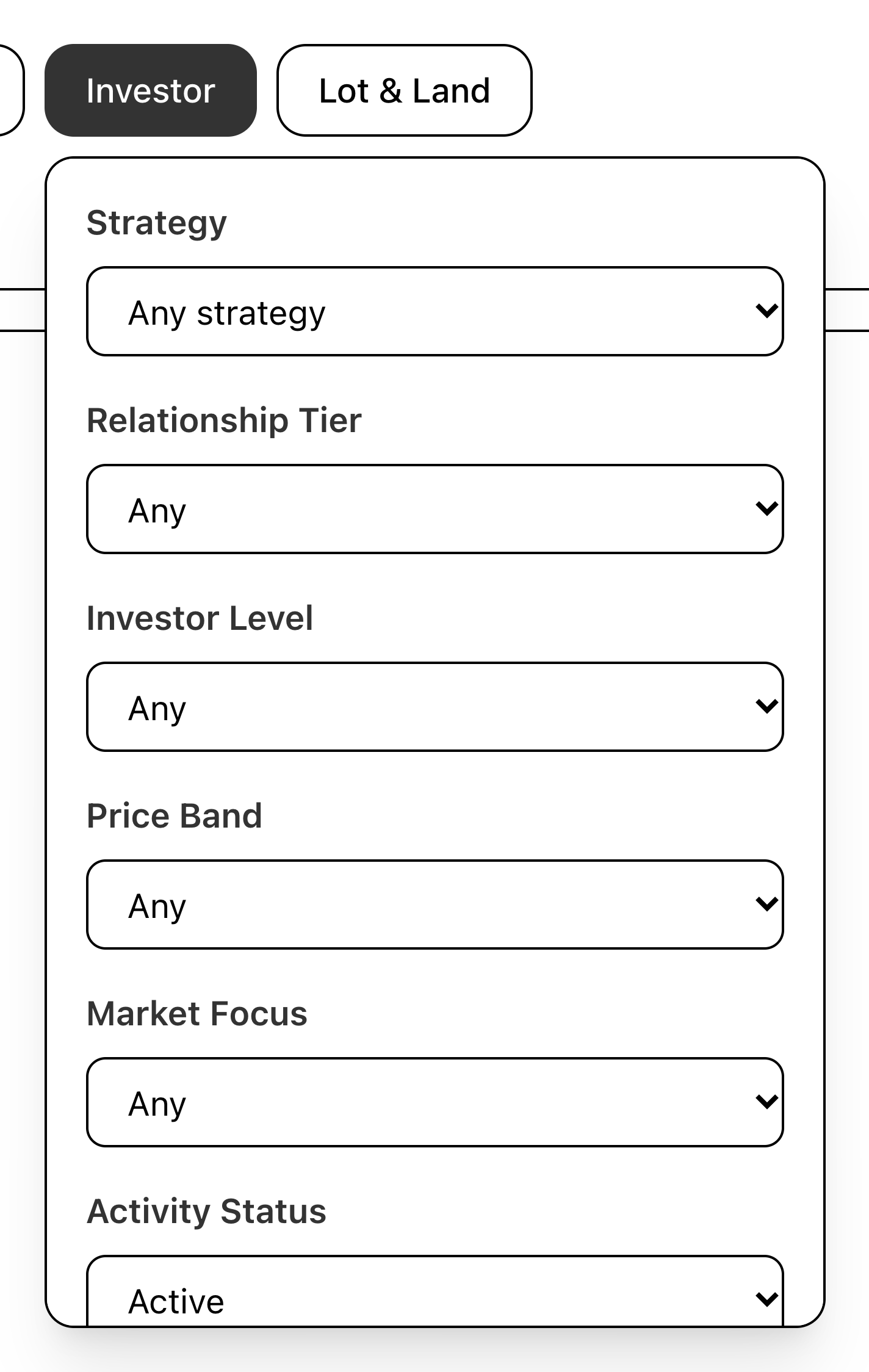 Activity Status separates investors still buying from those who have gone quiet.
If you are in a market where buying has cooled and you want to catch investors coming back, you can also filter to Re-Entering—investors who paused but have started transacting again. In a soft market, those are the buyers most worth a call this week.
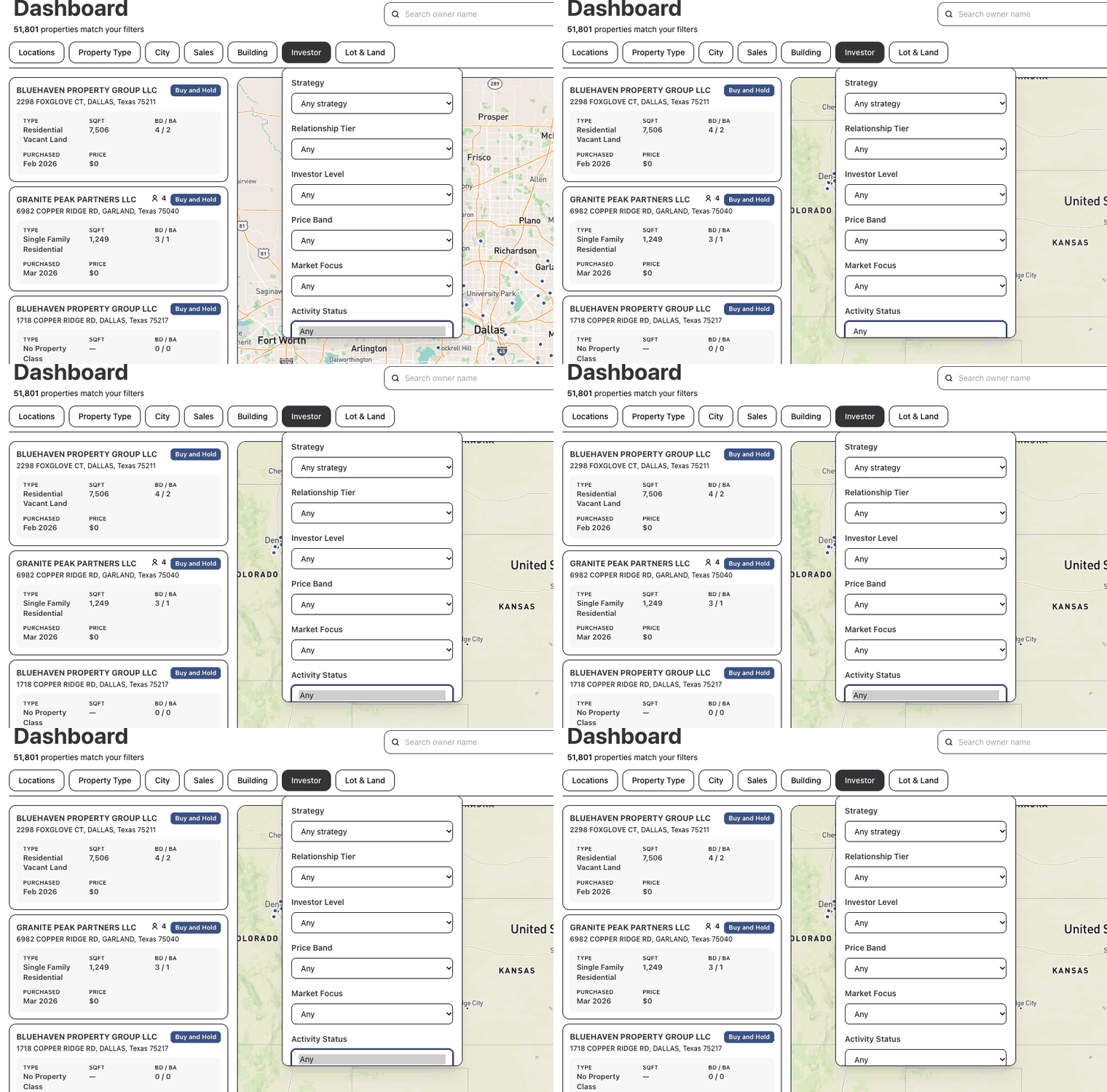 Four activity states, so a list ages honestly instead of silently.
Once you have your active buyers, filter by what they actually paid. Click the Sales pill and set a minimum and maximum on Purchase Price around your contract. If the active buyers in your county have not been paying anywhere near your number, that is not a dispo problem—it is an acquisition problem, and you want to find it before you sign.
 Price thresholds on the Sales panel.
Don't decide from the headline
The metro news will call your market hot or soft based on residential sales. That tells you nothing about whether a wholesaler can move a deal. Decide instead by checking the county's investor acquisition pace over 12 versus 24 months, then matching your contract to what active investors in that county actually buy. The buyers still closing deals are your list. The properties they buy are your lane. The prices they pay are your spread.
Two counties in the same region can have opposite dispo environments on the same day. Knowing which one you are in—and why—is the difference between a playbook that works and one that does not.